
Lockyer Residence / Shaun Lockyer Architects

Uploaded by — Filed under: Houses ,Selected , , , ,
 

© Scott Burrows

Architects: Shaun Lockyer Architects with Arkhefield
Location: Brisbane, Queensland,
Design Project Team: Shaun Lockyer, Julie Lockyer, Justin Boland, Michael Carlotto, Lucy Haynes, Jacquie Maestracci, Kellie Morris, Neva Wethereld
Builder: Bruce Wales
Engineer: Peter Ide, Westera Partners
Project Size: Original cottage 95 sqm, new works 65 sqm: Total 160 sqm
Project Year: 2009
Photographs: Scott Burrows / Aperture Photography

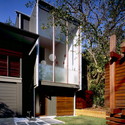
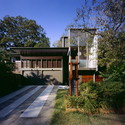
The “Lockyer Residence” is a small, contemporary extension onto a post war house in Bardon, a heavily treed and hilly fringe suburb in Brisbane. The design looks to address two primary architectural issues, the first is about context and language, the second is about finding the “essence” of what is needed from an accommodation/ resource perspective in an effort to create a engaging but practical and economical outcome.

The extension is essentially a “pod” added onto the end of a post war house which, while largely leaving the original house in tact, allows for the overall outcome to be reprogrammed. The architecture is unapologetic in its overt, contemporary nature that sits in stark contrast to the original. Notwithstanding this bold move, the original proportions and integrity of the cottage are left in tact to preserve the virtue of both.

ground floor plan

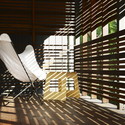
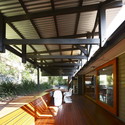
The planning, layout and architecture of the space is about the family, the connection to the landscape and the engagement with the sky. The space was to address the cold winters and to allow for increased summer breezes, both of which were inadequate in the original cottage.

The extension was an experiment in achieving a qualitative outcome at a very low cost. The process afforded a relatively high degree of craft and joy in what is essentially a very simple, easy to construct little box.

© Scott Burrows

1. Conceptual Framework

The design of this house is all about creation of a simple, cost effective “pod” that needed to accommodate the needs of a young family that had outgrown the original cottage. The other core function of the extension was to improve the connection to the landscape, engage with the sky and to provide a more climatically comfortable place to live, using the minimum resources possible to achieve this. The space is about joy.

2. Public and Cultural Benefits

The retention of the old cottage preserves cultural and architectural identity and more basically public expectation. The contemporary extension, while highly visible from the street, is partly concealed by the large tree on the site and gives over the landscape zone to the public realm. The house is highly animated at night forming a “lantern” that creates a sense of joy in the street for all.

© Scott Burrows

3. Relationship of Built Form to Context

The extension is a bold juxtaposition with the existing post war cottage. The form of the extension is highly contrasted while the material and colours play a more sympathetic role by referencing the vernacular. The extensive use of glass to the street allows for a minimal palette of materials to be expressed and reinforces the idea of old and new.

4. Program Resolution

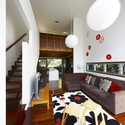
The need to be highly economical and sustainable, as well as being able to live in the house while building, determined a large degree of the planning. The extension houses the primary living area, kitchen and flexible room that functions as a study, guest bed and in the longer term, the main bed.

© Scott Burrows

5. Integration of Allied Disciplines

The outcome of this project is a reflection of a supportive and positive building process where the client and architect are one and the builder has had along association with the architect. Trust was there and the process allowed for boundaries to be pushed but in a cost effective and efficient way. The process was collaborative, experimental at times but cost effective and a great deal of fun.

6. Sustainability/ Environmental Consideration

There was a concerted effort in this design to address first principal design as there was no budget for “bells and whistles”. By virtue of having lived on the site for 6 years, we understood the sun, breezes, views etc which allowed us to tailor the space to make best use of light, air and amenity. Recycled and FSC timber (mostly), energy lighting, high spec insulation and fans were used. There is no air-conditioning.

section 01

Where possible the house has limited the use of applied materials. The ceiling under the mezzanine is the structural floor (as with the entry space) which not only shows off the structure but reduces the amount of resources used. The external cladding is also a environmental ply product rather than cement or fibre based product.

The space has also been designed to collect as much winter sun as possible to improve occupant comfort through the cooler winter months. All the material removed prior to building has been reused on the completed extension.

7. Response to Client and User needs

The challenge for this brief was to design a very small but sustainable space that could transform the use of a small house to meet the needs of a growing family. Allowing for flexibility in the brief and spaces to allow the house to “evolve” into the future was critical. Consideration of housing aging parents (abroad) and dealing with future needs of teenage kids all played a factor in the design, which so far is working out very well!

© Scott Burrows

Materials/Products

Roofing: Lysaghts, Zincalume “Spandeck”
External Walls: “Shadowclad” painted
Internal Walls: Spotted Gum T&G boarding / Gyprock walls generally throughout
Windows: Frameless Sash Windows by “Aneeta” / Louvres by “Breezeway”
Doors: Timber doors by “Allkind Joinery”
Flooring: Spotted gum throughout
Lighting: Kitchen pendant by LAD, Wall fittings by Small Australian Projects, Living room pendant are Ikea and balance by Beacon
Kitchen: Built by Allkind Joinery, appliances are Whirlpool and Fischer Paykel by Harvey Normal Commercial
Bathrooms: Mosaics by Bizazza, Wall tiles by Salvatore Ceramics, Sanitary fittings by Reece, Glass by Network Glass, Vanity basin by Ikea
External Elements: Paving and landscaping supplies through Gap Handyman Centre
Artworks: Wall mural by Charles & Ray Eames (from Eames Office California) / Aboriginal work by Narpula Scobie Napurrula / “Yosemite” paintings in dining room by Felicity Parker / Living room piece by Shaun Lockyer

* Location to be used only as a reference. It could indicate city/country but not exact address.
 
 
Thumb up Thumb down 0
Tonto says:

very impressi….zzzzzzzzzzzzzzzzzzzzzzzzzzzzzzzzz

 
# May 11, 2010 at 03:11
Thumb up Thumb down 0
Poker Face says:

This house is a joyful. ‘Joy in the street for all’ is very admiring plan.

Well done!

 
# May 11, 2010 at 03:12
Thumb up Thumb down 0
pom pom says:

Acertada simbiosis entre un diseño vanguardista y un entorno naturala. bravo shaun locyer architects! :-)

 
# May 11, 2010 at 03:19
Thumb up Thumb down 0
Bruce says:

I like the juxtaposition of the new addition and the reconfigurations of the bungalow, but it feels a bit large to call sustainable. The use of other adjectives is also a bit contrived: joyful – obviously the owner/architect is happy with his new design – it is beautiful; cost-effective – this hardly seems to be an economical solution given the high-end fixtures, fittings and finish materials used; but it is a commendable solution if in fact no air-conditioning is used in that climate. I was only in Brisbane for a 7-hour layover in late February, but it was very hot and very humid very early in the morning.

 
# May 11, 2010 at 10:45
    Thumb up Thumb down 0
    Shaun says:

    Bruce, thanks for the comments, it’s always good to have feedback. With regards to size & cost, the extension is 65sqm (approx. 600 square feet) & cost AUD$1,900 per square metre, so by Brisbane standards represented a pretty cost effective outcome. Cheers, Shaun.

     
    # May 11, 2010 at 18:51
      Thumb up Thumb down 0
      Craig says:

      I think the house looks great, I am having trouble finding a contact number for you though, can you supply?

       
      # June 2, 2010 at 06:28
Thumb up Thumb down 0

I'd Live Here: Lockyer Residence. http://bit.ly/9XuQTm

 
# May 11, 2010 at 18:31
Thumb up Thumb down 0
WPstudios says:

RT @nicholaspatten I'd Live Here: Lockyer Residence. http://bit.ly/9XuQTm

 
# May 11, 2010 at 18:32
Thumb up Thumb down 0
Lindy says:

Great work Shaun! You and Julie must be very happy there. Perhaps we can use this as one of the QUT 2nd Year Architecture Exemplar Houses next year?! :) Hope you are well.

 
# May 11, 2010 at 23:09
    Thumb up Thumb down 0
    Shaun says:

    Always…..anything for you!

     
    # May 16, 2010 at 20:45
Thumb up Thumb down 0
CRISTIAN says:

Beautiful night picture!

 
# May 12, 2010 at 00:16
Thumb up Thumb down 0
Rosli says:

I like this house!

 
# May 12, 2010 at 00:46
Thumb up Thumb down 0
sniper says:

big thumbs down

 
# May 12, 2010 at 01:46
Thumb up Thumb down 0
loosman says:

bruce, shaun – what does ‘cost effective’ say anyway? I heard that one can still build a family home for $900/ quadratmeter in Brisbane. I also know a family in Australia who lives in a house with total living area of 65qm….

architect, your words should match your pictures – one won’t always be present to defence the critique.

 
# May 12, 2010 at 01:55

Leave a Reply »


Latest Comments »

Architecture has been and always...[+]
I think the idea of the whole project...[+]
Another useless piece of junk from him – except this time it is dangerous!...[+]
Coffee with an Architect has got to stop; it’s pathetic.[+]
Has archdaily started a new...[+]

Upcoming Architecture Events »

got events? invite us! click here

Architecture Books & Magazines »

The New Modern House: Redefining Functionalism

The New Modern House: Redefining Functionalism


The New Modern House is a comprehensive look at the emerging trend of architecture that favors substance over style, combining functional design and sustainable processes with a straightforward, honest aesthetic.The New Modern House features 50


Reverse Effect: Renewing Chicago’s Waterways / Jeanne Gang

Reverse Effect: Renewing Chicago’s Waterways / Jeanne Gang

Our friends from Studio Gang Architects recently sent us their new book Reverse Effect. ”The culmination of a yearlong collaboration between Studio Gang Architects and the Natural Resources Defense Council (NRDC), Reverse Effect is dedicated to exploring the importance of


Strategy Space / a+t: Landscape Urbanism Strategies

Strategy Space / a+t: Landscape Urbanism Strategies

Landscape Urbanism is the new black in architecture and this magazine, part of a+t strategy series, has heads turning. There are a dozen projects and hundreds of ideas in this edition. A recurring them is the manipulation of time…


Our partners »

AD on iPad via Pulse

Browse by date »

Browse by category »

Friends »