
Pael House / Pezo von Ellrichshausen Architects
Architects: Mauricio Pezo, Sofia von Ellrichshausen
Location: Concepcion, Chile
Client: Gabriela & Humberto Broitman
Collaborators: Konstantin Konig, Ivan Fierro
Structure: German Aguilera
Construction: Claudio Loosli
Sanitary project: Marcelo Valenzuela
Electrical project: Carlos Martinez
Model photography: Ana Crovetto
Plot area: 500 sqm
Built area: 287 sqm
Project date: 2007
Construction date: 2008-2009
Architecture Photographs: Cristobal Palma
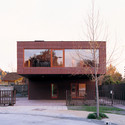
We decided to test the archetypical features of the suburban house. This exercise was never as explicit as the conciliation required by the formalities of the case: a suburban dwelling in a neighborhood of detached houses. As the rest of the residences, this was a big house in a plot too small for such a size; a house that had to look like one (for the sake of the neighbors mental peace); a house made of “material” (a local expression referring to the unquestioned solidity of concrete constructions) that would never age (for the peace of mind of the owners).
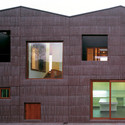
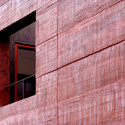
In an almost automatic move we proposed a heavy and clumsy rectangular prism that echoed the cornered site tucked away at the end of the street; we projected an extension of the plot in two elevated dry patios; we planned a piece that unified the silhouette of four pitched roofs, not too different from the naïve outlines of a child’s drawing; we built a secondary pigmented concrete wall that was repaired several times during its crafted fabrication and that was build in layers so that each new one spilled itself over the previous one. “It’s the weeping house” a carpenter said while he varnished the boards of the furniture “perhaps the only way to avoid aging is to be born old”. Of the four infantile silhouettes only the one closest to the street does not have a base. It is a transversal block suspended over the little remaining air offered by the neighborhood’s square.
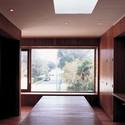
When Colomina talks about Graham’s inbuilt project she teaches us that “since each house in the urbanization faces an almost identical one across the street, its window becomes another identification screen, a kind of mirror”. In this case, the mirror occupies a place unreachable to the direct eye. It is a disproportioned showcase that allows intruders to enter only when they look from a distance.
- © Cristobal Palma
- © Cristobal Palma
- © Cristobal Palma
- © Cristobal Palma
- © Cristobal Palma
- © Cristobal Palma
- © Cristobal Palma
- © Cristobal Palma
- © Cristobal Palma
- © Cristobal Palma
- © Cristobal Palma
- © Cristobal Palma
- © Pezo von Ellrichshausen Architects
- location plan
- floor plans
- roof plan
- elevations 01
- elevations 02
- sections 01
- sections 02
- axo 01
- axo 02
- axo 03
- sketches 01
- sketches 02
- sketches 03
- model 01
- model 02
- model 03


Intense. Deliberate. Very powerful.
The concrete wall construction must have been fascinating to experience (and could be included in photographs). The structure feels very “hand-made,” and perhaps that is what empowers it. Could there have been more done with the overall use of the wood to make the interior seem less patterned and predictable? -sure. The proportions overall, but especially the width of the walls, seem well balanced.
Another awsome project from the one and only Pezo von Ellrichshausen Architects!
one of the best chilean architects of the moment.
is a pleasure to see such resolutions in a house in Chile, which may well have been a real estate home more of concepción.
i’d like to see Pezo von Ellrichshausen Architects in larger projects or in larger buildings in urban chilean cities, rather than private homes.
agree: a beautiful project by a great practice, which should perform on a wider, international stage, as their architecture, in concept and execution, is by far outstanding!
Cool but the cantilever does nothing special volumetrically or spatially outside of itself being a cantilver
Disagree… The cantilever creates a covered space adjacent to the public street… you might call it a front porch.
dont like it, seems a prision…the cantilver looks too odd
SUCH AN AUTHENTIC WORK. FROM THE BENNING TO THE END, IN ALL IT`S DESSICIONS. THE ONLY THING MISSING ( an least for me) ITS THE CHIMNEY…..
4 R2D2`S AND 5 CRPO`S!!
I'd Live Here: Pael House. http://bit.ly/9GpBh1
inimitable style, cubic Gaudi.
PatrickLBC,
yes the cantilever DOES DO SOMETHING but it’s not really enough.
you could make an argument that everything does something…and sooner rather than later we will talk about frank gehry and how each curve and swoosh in his buildings “DO” something in relation to haptics etc.
What the cantilever needs to do..is DO MORE. TO ME..it doesn’t really communicate to me because a) it’s actually NOT COOL enough of a gesture and not complex enough of a move b) it doesn’t really DO ENOUGH. Ultimately, it isn’t artistic enough of a move nor is it that intelligent enough. And from a functional point of view…to have something cantilever out for 5 meters just to create a covered canopy is pretty weak. I can buy a giant umbrella that attaches to those plastic tables i use when i BBQ in the rain…to do that.
THE OTHER thing is that the cantilever seems inconsistent with the processes/concept that the rest of the building deals with. IT is a break in conception and process.
It is cool to have anomalies….and really the cantilever is pretty cool……but not good enough.
7:44 AM Nov 3rd
Pael House / Pezo von Ellrichshausen Architects | ArchDaily http://t.co/yrT3Mqp5 via @archdaily