
Clover House / Katsuhiro Miyamoto & Associates

Uploaded by — Filed under: Houses ,Selected , , ,
 

Architects: Katsuhiro Miyamoto & Associates
Location: Nishinomiya, Hyogo,
Principal in Charge: Katsuhiro Miyamoto
Project Team: Isamu Tamaishi
Collaborator: Masahiro Miyake / y+M design office
Structural Engineering: Masaichi Taguchi / TAPS
General Contractor: Kohatsu
Site Area: 117.44 sqm
Built Area: 46.95 sqm
Total Floor Area: 76.19 sqm
Project Year: 2007
Photographs: Courtesy of Katsuhiro Miyamoto & Associates

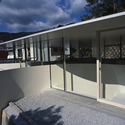
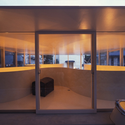
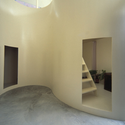
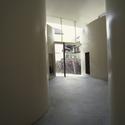
A housing land development ground and the existing retaining wall were excavated to create space with double-height in the basement, and, in addition, a flat glass box was layered on the ground to accommodate the house space to dwell. It has been proved that excavate techniques enables spaces to be free-formed. A cloverleaf hall with 4.6 meters ceiling height is a common space for the family, and following this space, some laterally excavated spaces lies, which looks like Yaodong, Chinese traditional underground houses, and the each space functions as a private room for study and kitchen and bathroom.

floor plan

Three loft alcoves on the ground level are private bedrooms. It means that the relationship between the shape of three clusters in the basement and of bedrooms on the ground level in reversal as negatives and positives. Each bedroom relates to the exterior space. For example, loft-2 relaxes narrowness of the floor in hard numbers by projecting an adjacent retaining wall at the north side as a screen. Moreover, one can approach directly to their own bedrooms through the outside stairs.

© Courtesy of Katsuhiro Miyamoto & Associates

In structure, a matter of great interest is how to resist sliding caused by earth pressure of adjacent lots on the north and east side. Nine millimeters thickness iron plate is used as both a mold and finishing material. The mold is filled with cement so that resistance to the pressure is gravitationally solved.

steel paneling details

© Courtesy of Katsuhiro Miyamoto & Associates

The iron plate used for the finishing side was prefabricated dividing it into 16 blocks, and all of the joints were merged into each other to completely weld so that the plate itself wound be an effective water proved layer.

* Location to be used only as a reference. It could indicate city/country but not exact address.
 
 
Thumb up Thumb down 0
INawe says:

There is so much unusable space created by the meandering wall but I do love the “paper” thinness of the walls.

 
# April 16, 2010 at 13:52
    Thumb up Thumb down 0
    INawe says:

    I would love to see the roof details as well because its executed so beautifully.

     
    # April 16, 2010 at 13:54
      Thumb up Thumb down 0
      Teo says:

      INawe you have the roof details right there, just click and enjoy.

       
      # April 16, 2010 at 14:13
Thumb up Thumb down 0
shetu says:

I don’t understand what is actually happening at the first floor. Though you tried to solve the lighting with some circular shaft, they look insufficient for that purpose. The enormous common space looks unusable as well. I liked the entry. Its a nice try I think. Keep it up and try to post details described in English. Thanx for sharing.

 
# April 17, 2010 at 02:26
Thumb up Thumb down 0
AV says:

No wonder they don’t have handrails…. paper thin walls make impossible fixings. The acoustics obviously don’t bother them that much…

 
# April 17, 2010 at 05:08
Thumb up Thumb down 0
arnold says:

it’s fantastic, that there’re so crazy people, who built such houses (architects) and who live here (clients). Very unusual and interesting Way of thinking.

the structure of the house is very simple, but and the same – difficult (the difficulties I see in searching Idea of this house). well,.. the house isn’t very concept and nice, but he is intersting. and I thing it is important :-).

 
# April 17, 2010 at 07:31
Thumb up Thumb down 0
rodger says:

only the japanese could build something so refined, elegantly simple, and horrendous at the same time. for most of us, this space is the epitome of an unlivable and claustrophobic space done with artistry.

 
# April 17, 2010 at 10:56
    Thumb up Thumb down 0
    c says:

    this.

     
    # April 19, 2010 at 21:29
Thumb up Thumb down 0
rsantosfernandes says:

i like the main idea, but not for a house. it seems to me that
they live in the mold for alvar aaltos´s savoy vase.

 
# April 19, 2010 at 23:22
Thumb up Thumb down 0

3:12 PM Apr 16th

mto bem resolvida..gostei! RT @archdaily Clover House / Katsuhiro Miyamoto & Associates http://archdai.ly/bkdqF8

Thumb up Thumb down 0

6:09 PM Apr 18th

A cloverleaf hall with 4.6 mtrs ceiling height is a common space for a family by Katsuhiro Miyamoto & Associates http://bit.ly/c08FED

Thumb up Thumb down 0

11:11 AM Jul 17th

衝撃…。これを見るとソトとウチを明確に分けて認識していることが凄く愚かなことに思えてしまう。。 http://bit.ly/c08FED

Leave a Reply »


Latest Comments »

“ditto”[+]
Architecture has been and always...[+]
I think the idea of the whole project...[+]
Another useless piece of junk from him – except this time it is dangerous!...[+]
Coffee with an Architect has got to stop; it’s pathetic.[+]

Upcoming Architecture Events »

got events? invite us! click here

Architecture Books & Magazines »

Thermally Active Surfaces in Architecture / Kiel Moe

Thermally Active Surfaces in Architecture / Kiel Moe

Departing from the simple question Why do we heat and cool buildings with air?, this book focuses on the technique of thermally active surfaces. This technique uses water in building surfaces to heat and cool bodies – a method


Urban Interventions / Vallo Sadovsky Architects

Urban Interventions / Vallo Sadovsky Architects

Vallo Sadovsky Architects recently sent us their latest book, Urban Interventions. We have featured one of Vallo Sadovsky Architects’ projects before, BA_LIK. That project gets to the heart of what this book is about. Small urban interventions can completely transform and…


Event: Tom Kundig and Mark Rozzo – Architectural Explorations in Books, a conversation presented by New York Public Library

Photo by Tom Bies | Courtesy of OSKA Architects

[ January 25, 2012; 18:00 to 20:00. ] Tomorrow, the New York Public Library will be hosting a talk between architect Tom Kundig of Olson Kundig Architects and Town & Country Executive Editor Mark Rozzo that will discuss “the role of place, nature, materials and craft in creating Kundig’s bold and…


Our partners »

AD on iPad via Pulse

Browse by date »

Browse by category »

Friends »