
House of Integration / FORM | Kouichi Kimura

Uploaded by — Filed under: Houses ,Selected , ,
 

© Takumi Ota

Architects: FORM/Kouichi Kimura Architects
Location: Shiga,
Client: Private
Construction Year: 2010
Site Area: 166,21 sqm
Constructed Area: 116,06 sqm
Project Year: 2010
Photographs: Takumi Ota

This is the house for a young couple and their child.

The client had a longing for the traditional Japanese folk dwellings, and desired to take advantage of the surrounding bountiful idyll in the new house.

ground floor plan

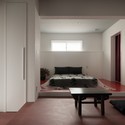
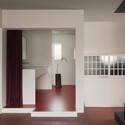
We planned in the center of the first floor a spacious foyer that functions as a semi-exterior area.

© Takumi Ota

This space, which evokes relation between the DOMA (dirt floor) and ZA (habitable space floor) often seen in the old Japanese folk dwellings, is connected with the couple’s bedroom, child room, bathroom, and stairway to the second floor. It plays a role as the core of the flow line inside the house, and can be used in a variety of ways in accordance with the client’s needs.

© Takumi Ota

The living room, dining room, and kitchen are laid out on the second floor.

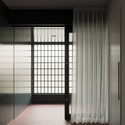
We designed so that the line of sight is led by colors and lights when you go upstairs, to the idyllic scenery that spreads outside the opening.

© Takumi Ota

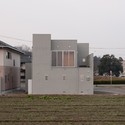
The house, though it may be compact, integrates diversified and productive spaces produced by various materials and colors, in its minimal volume that blends in with the idyll.

* Location to be used only as a reference. It could indicate city/country but not exact address.
 
 
Thumb up Thumb down 0
enceladus says:

nothing special…

 
# March 16, 2010 at 13:08
Thumb up Thumb down 0
boxcutter says:

Arch Daily, seriously. STOP IT! these japanese minimalist-esque houses are like 3rd year design student projects. This is suposed to be a showcase of new ideas, creative material usage, beautiful details, and playful expression…

 
# March 16, 2010 at 14:09
Thumb up Thumb down 0
DougO says:

I realize this is an example of the culture of design as well as the culture itself… but it is just to sterile for me.

 
# March 16, 2010 at 14:13
Thumb up Thumb down 0
anavic says:

Who tells this people how to do plans? seriously,… there is no distinction between the toilet and the walls. Lines don’t talk by themselves. I think it’s better to draw a scheme with the basic furniture than let it empty and write: LIVING

Am I wrong if I say that I’m in my second – third year at univertity and I think I could draw better?

Maybe that’s the thing of minimalist houses, but anyways, I think every single project should be explained by itself and I think this drawings say nothing without the words in bold.

 
# March 16, 2010 at 15:01
    Thumb up Thumb down 0
    anavic says:

    My apologies if I offended anyone.

     
    # March 16, 2010 at 15:02
      Thumb up Thumb down 0
      yeah says:

      Before you actually BUILD your first building you know NOTHING.

      This is not University – nobody really cares if you draw a bed in the bedroom etc.

      These plans are enough to see what’s going on and every architect fills the space with furniture just by understanding the proportions of the room.

      Your criticism tells more about your lack of experience in the field than about this office – and believe me, looking at the quite clean details and interiors (I’m not touching the concept) there had to be quite a lot of nice technical drawings that would satisfy your drawing-needs.

       
      # March 17, 2010 at 04:30
      Thumb up Thumb down 0
      anavic says:

      From what you’ve said (“yeah”) I understand that proportions are not important enough to be shown in this project?! Then why to draw everything in the bathroom and let the rest half-naked? Don’t tell me it’s because they don’t want to set a layout because it’s up to the owners because I don’t believe that, if they wanted that they shouldn’t have writen the “names” of the rooms.

      I’m not saying it’s not a good project, I’m saying that it’s a pity that they don’t want to be too expressive. I actually like the project, stop attacking me as if I had a better project, which I perfectly know I don’t

       
      # March 17, 2010 at 14:41
    Thumb up Thumb down 0
    Mac says:

    Even when the design is mediocre, which I ain’t stating, you have to value the fact that the architects got it built. Anavic, if you are that super designer, try to get your idea relialised!

     
    # March 17, 2010 at 00:41
      Thumb up Thumb down 0
      anavic says:

      I know I don’t know a thing.

      I’m not saying I could have made it better. I’m just saying that from what I’ve seen architects tend to forget about basic things they learn at university.

      Everything is important, the plans included. I don’t now the translation but le corbusier said: “la planta es el generador de todo”.And I think that they could have put more effort on it’s appearance. It sometimes feels like: now that I’m an architect I can do things my own way and nobody will dare to criticise me.

      I don’t like it when people takes things for granted.

       
      # March 17, 2010 at 14:29
Thumb up Thumb down 0
why says:

why don’t we get a forum, where all the critics on this website can upload their excellent work?
i am sure, all we will get is some commercial average designs to a market of average u.s. citizens living in average u.s. suburbs…
guys, stop trying to make youself better by just shitting around from the dark – just present something great on this website, and the world will be a better place!

 
# March 16, 2010 at 15:45
Thumb up Thumb down 0
lex says:

WOW! finally a design that proves that one can be too japanessey with a design. I thought this day would never come.

 
# March 16, 2010 at 15:45
Thumb up Thumb down 0
pathos says:

Try as I may I can’t see how this project deserves the harsh criticisms that it has garnered so far. And it is not the responsibility of ArchDaily to judge these projects and deem which are worthy of our time and which are not – that is for you to decide. The plans, while admittedly low contrast, read just fine to me. I don’t see how the spaces are particularly overly-Japonesque. What I see is a well articulated and efficient allotment of space to suit the needs of a small family. Everything appears to be lovingly and carefully considered and detailed. The color palette is refreshingly saturated relative to the all white interior it could have been. Maybe the natural lighting could have been better but privacy could have been an issue. It seems that the clients got the house they wanted.

 
# March 16, 2010 at 17:43
Thumb up Thumb down 0

While I personally don’t think the severity of these criticisms are warranted, I do find it odd that a project that champions itself on integration is so formally and contextually isolated from its environment. The description speaks to the integration of the interior volumes but it is quite sterile and stand-offish from the exterior.

Aside from that, I think its important that architecture leaves something open for interpretation. Architecture should not be 100% definable or discernible at first blush and if it is, there is a good chance you only have a building. Building is not equal to architecture…

 
# March 16, 2010 at 19:53
    Thumb up Thumb down 0
    kimbo says:

    “I do find it odd that a project that champions itself on integration is so formally and contextually isolated from its environment”
    homes should reflect the people living in them, some of us are actually like the above extracted, detail~quote from Ballista.

     
    # March 17, 2010 at 12:56
      Thumb up Thumb down 0

      There is no argument that homes should reflect those living within…from an architectural perspective, however, the expression of these personalities should not become a disruption to the existing EXTERIOR fabric. There are a slew of architectural approaches and techniques that would allow for the level of privacy without fragmenting the context. Homes are an expression, definitely…but if everyone’s individual expression(s) were translated to architectural form, then there would be no discernible context.

      A nice enough project; just hesitant to buy into the project as “integrative”. Cheers!

       
      # March 17, 2010 at 13:14
      Thumb up Thumb down 0
      kimbo says:

      @Ballista Magazine. if the existing “exterior fabric” you mention is akin to to the popularisation of the extended family, then from a balanced perspective, the nuclear family ie, interior integration as a modern represention on a house of integration form, as by Kouichi Kimura, ought to be also given as much gravitas.
      However, in terms of the meanings of integration, we need to address it s context here, in both an internal and external sense. There should be scope for an external house of integration, by way of developing such needs as the modern (not postmodern) family moves from pre school/pre exterior activity and needs due to insular aspects of early parenthood, through to a natural progression that integrates with the exterior fabric. Of course there are many variables, but babies and small children really only require an environment that inches rather than morphs from that of the womb, at the very least until walking the talk age.
      A postmodern family of course would skip completely interior integration, but of course, thereto are variables.
      It is my opinion that these modern houses of integration form, encourage a more spiritual life within the context of their current, existing, exterior fabric.

       
      # March 22, 2010 at 17:02
Thumb up Thumb down 0
Jubair Siddeeque says:

Its been long since the last project of Form-Kimura. I usually Check their website time to time to see new postings. But not till now.
I rate this as a good one. very typical of their style. I notice they have tried some variations like, Non-glossy floor, Textured wall finish and yes, red color is first time, i think, on their floors.
Expect more new from their work. Their work is always at this scale. I am big Fan. Keep up the good work ‘Arch daily’

 
# March 16, 2010 at 23:40
Thumb up Thumb down 0
dariusz says:

A bit sterile, like someone mentioned.. There’s absolutely no integration with the exterior or surroundings.. I am getting really bored with this kind of work.. way too boring..

 
# March 17, 2010 at 05:16
Thumb up Thumb down 0
arnold says:

it’s a strange house:
- when I’m looking at exterior, I see some kind house from Middle East (turkiye, syria, iraq and etc.);
- when I’m looking at the interior, it looks like european 70th “modern” architecture solutions.

and a bit strange, when if your quests wants to get to the house living room, they must go through your masters bedroom :-) (this intimate area is too much open).

well, anyway this house has only a little japanese spirit. it’s sad a bit..

 
# March 17, 2010 at 18:19
Thumb up Thumb down 0
toni says:

I find it stunning how formally coherent is all the works of FORM

 
# March 18, 2010 at 10:20
Thumb up Thumb down 0
d.teil says:

@arnold:

that is funny as u mention this house has just a bit japanese spirit after u are telling the reader the strangeness about the floor plan.

well, study the original japanese house, then u will see that this house has more japanese spirit as u are thinking (incl. the facade).

 
# March 19, 2010 at 09:34
Thumb up Thumb down 0
d.teil says:

@arnold; just forgot…………….. beside this u also should study to read a floor plan first (especially how you have to read a staircase). of course nobody has to cross here a bedroom first.

 
# March 19, 2010 at 09:39
    Thumb up Thumb down 0
    anavic says:

    I’m sorry but you’re wrong. You do have to cross the bedroom first.
    The “public” area is upstairs and although you don’t literally cross the bedroom zone it’s all opened. And even worse, the first thing you see is the toilet sink, a curtain does not make the function of a door to me.
    I’m not criticising their privacity preferences, I just say what it is and what it looks like in the floor plan.

    I don’t know how do you read floor plans btw

     
    # March 19, 2010 at 11:07
Thumb up Thumb down 0
G says:

Kimbo has a point…wonder where the humans are…have noted that the year of construction (completion?) is 2010…that would mean that the house has not been lived in or broken in yet?…would be interesting to see what the spaces look like after the young couple and their child have lived in it for a while ( cutlery, paintings on the wall, artifacts,sculptures, the child morphing into a teenager, then into a young adult, favourite rocking chair and such). am not sure if the photographs do justice to the project…it comes through as a beautiful piece of sculpture.the house was designed to meet the requirements of the family so i guess one can not deny that it is a reflection of their tastes…what is their lifestyle?…what kind of a relationship do they have with their child…is it formal?…do they not let their hair down after work or on weekends?…perhaps eventually the spaces will fuse with the spirit of the family and reflect in a more complete manner the people living in it…the family will humanise it!…am curious.

 
# March 22, 2010 at 14:20
Thumb up Thumb down 0
vend core says:

E ai pessoal, apenas me alertei a respeito do seu weblog por Google, e pensei que ele e de fato informativo.So elogios pela ideia de nos agraciar esse trabalho repleto de primeira linha.Ate logo aos parceiros, nos comunicamos outra hora.TCHAU

 
# October 6, 2011 at 09:48
Thumb up Thumb down 0

1:35 PM Mar 16th

ArchDaily: House of Integration / FORM | Kouichi Kimura http://bit.ly/cLpGCI

Thumb up Thumb down 0

1:37 PM Mar 16th

RT @archdaily House of Integration / FORM | Kouichi Kimura http://archdai.ly/a3UyPt

Thumb up Thumb down 0

2:13 PM Mar 16th

House of Integration / FORM | Kouichi Kimura | ArchDaily http://shar.es/moLtO The front of this house is amazing!

Thumb up Thumb down 0

2:21 PM Mar 16th

House of Integration / FORM | Kouichi Kimura: © Takumi Ota
Architects: FORM/Kouichi Kimura Architects
Location: Sh… http://bit.ly/caATKK

Thumb up Thumb down 0

2:47 PM Mar 16th

#architekt House of Integration / FORM | Kouichi Kimura: © Takumi Ota
Architects: FORM/Kouichi K… http://bit.ly/d2j1Qf #in #Robert_Scholz

Thumb up Thumb down 0

5:40 PM Mar 16th

House of Integration / FORM | Kouichi Kimura http://bit.ly/95MlOg

Thumb up Thumb down 0

7:03 PM Mar 16th

Lovely! RT @HomeDecorNews House of Integration / FORM | Kouichi Kimura http://bit.ly/95MlOg

Thumb up Thumb down 0

7:08 PM Mar 16th

RT @grahamcowen: Lovely! RT @HomeDecorNews House of Integration by FORM | Kouichi Kimura http://bit.ly/95MlOg #architecture #minimalism

Thumb up Thumb down 0

7:00 PM Mar 17th

@meusonhodeconsumo House of Integration / FORM | Kouichi Kimura http://archdai.ly/a3UyPt

Thumb up Thumb down 0

6:54 PM Oct 3rd

House of Integration / FORM | Kouichi Kimura | ArchDaily http://t.co/IJDYeTX9 с помощью @archdaily

Thumb up Thumb down 0

10:27 AM Nov 27th

House of Integration / FORM | Kouichi Kimura | ArchDaily http://t.co/BpPgqKc6 via @archdaily

Leave a Reply »


Latest Comments »

Another useless piece of junk from him – except this time it is dangerous!...[+]
Coffee with an Architect has got to stop; it’s pathetic.[+]
Has archdaily started a new...[+]
I’ll add one, based on these comments: Architects are easily offended.[+]
Just something he learned from Rem Koolhaas, again and again...[+]

Upcoming Architecture Events »

got events? invite us! click here

Architecture Books & Magazines »

Cebra Files 02

Cebra Files 02

We recently received a monograph of Cebra’s work. This young firm is energetic, pushes the boundaries, goes after competitions, and has been successful in pushing many projects into reality. We are fan their work and have featured Cebra 16…


After Crisis

After Crisis

“‘After Crisis’ concentrates around the new conditions for architectural practice and around the new epistemologies that may inform it in the next future. That is, in the period after the financial bubble has collapsed and living and working conditions


Architectural Lighting: Designing with Light and Space / Hervé Descottes with Cecilia E. Ramos

Architectural Lighting: Designing with Light and Space / Hervé Descottes with Cecilia E. Ramos

As part of Architecture Briefs series, produced by The Foundations of Architecture, this short book on lighting gives a very good introduction into architectural lighting. The authors start by explaining the six visual principles of light; illuminance, luminance,…


Our partners »

AD on iPad via Pulse

Browse by date »

Browse by category »

Friends »