
Living Around a Patio / Julio Barreno

Uploaded by — Filed under: Refurbishment ,Selected , ,
 

Architect: Julio Barreno
Location: Ubrique,
Technical Architect: Rocío Román Aguillar
Project Year: 2009
Photographs: Julio Barreno

Taking a look to an aerial view over the historical centre on the city of Ubrique, it advises us about the importance of the patios in the traditional typology of this city. The existence of these patios makes fluffier the high density of the historical centre of these cities in the south. This is very important to protect the people from the hot weather.

@ Julio Barreno

This proposal in Colon square is a restoration of an old building with traditional character.

The works on the façade were only a process of cleaning or rubbing a lot of ornamental elements that made it a bit dirty. I decide to simplify the appearance using two or three elements from the original façade; the wholes (wooden windows), the balconies, with the original railings; and also the number above the main entrance.

@ Julio Barreno

The colour used in Ubrique for the facades is fundamentally the white one; this is something that the authorities force to.

Using this white colour in our proposal we found a way to get that several traditional elements construct a new abstract language, specific for this building. Some of the figurative traditional elements are able to design a new appearance for this new element in the city.

The program is a singular housing in the upper floors and a local in the ground floor.

@ Julio Barreno

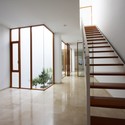
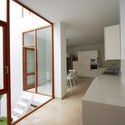
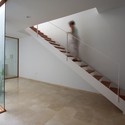
The patio in the original house was another important green point in the Ubrique´s map. In the new proposal the patio is considered always as a GREEN ELEMENT, a NATURAL ELEMENT. This is the origin of the design of the rest of the elements that complete the building. This is why the wood used for the design of the windows that delimit the patio has a natural appearance as well as the steps of the stairs that link the first and second floor.

floor plans

The floor is constructed using compressed soil, because that is what beige marble is at last.

The ceilings are also treated as natural elements, probably trees, covering different areas inside; one of them controls the space above the stairs and the other one distinguish the dinner area from the living one.

@ Julio Barreno

I like to see this as a NATURAL LANDSCAPE INSIDE.

The fluency of the floors is the most important theme in this project. We have to talk about just one space that is composed of different areas delimited with light glass walls and mobile elements.

@ Julio Barreno

In this house you live around a patio, this is the structural topic of the house. Here you need to move across this landscape, around the patio, to understand the house, to live in it, organizing the program you live in a sequential way.

During the day the patio is the main space, through it, the house receives a lot of light and sun, and it fills up of life. At night, it becomes a singular element that links visually different rooms in different floors.


Thumb up Thumb down 0
Lumiges.com says:

Clean, simple, but effective design. I guess some personal touch by lucky resident would be required. I am not sure about kitchen cupboard setup though, looks rather unconventional. Generally looks like good place to live. Lumiges.com

 
# February 17, 2010 at 02:52
Thumb up Thumb down 0

ArchDaily: Living Around a Patio / Julio Barreno http://bit.ly/bpQrM1

 
# February 17, 2010 at 06:11
Thumb up Thumb down 0
arhitectura says:

Living Around a Patio / Julio Barreno: @ Julio Barreno
Architect: Julio Barreno
Location: Ubrique, Spain
Tec… http://tinyurl.com/yke5lbt

 
# February 17, 2010 at 06:11
Thumb up Thumb down 0
jin says:

great use of color

 
# February 17, 2010 at 05:36
Thumb up Thumb down 0
cortebrezo says:

Living Around a Patio / Julio Barreno http://j.mp/boJJuw

 
# February 17, 2010 at 06:53
Thumb up Thumb down 0
Małgorzata says:

Lovely idea with this orange column and ceiling.

 
# February 17, 2010 at 07:09
Thumb up Thumb down 0
Ace says:

http://bit.ly/bpZg5n Typographic architecture? Was the big Orange T intended?

 
# February 17, 2010 at 08:59
Thumb up Thumb down 0
frank says:

Creo que restaron un valor importante a la construcción. El patio se solucionó de una forma corriente, con macetas (ojo no estoy en contra de las macetas pero al menos se debió encontrar un uso más sensible a dicho término). Y los interiores se hicieron convencionales, pladur, algo de madera y un acento de color. Viviendas como éstas demandan renovaciones sensibles, exposición de los materiales constructivos originales, contrastes morfológicos y otras figuras que de seguro enriquecen un espacio históricamente valioso e inamovible actualmente. Creo que han habido renovaciones (por ejemplo las hechas en masías y las casas urbanas en áreas históricas que proyectó Coderch) que sacan una expresión mucho más concreta de la referencia histórica como participante de la arquitectura actual.

 
# February 17, 2010 at 09:33
Thumb up Thumb down 0

Living Around a Patio / Julio Barreno | ArchDaily: The patio in the original house was another important green poi… http://bit.ly/ck0Zqv

 
# February 17, 2010 at 10:37
Thumb up Thumb down 0

Living Around a Patio / Julio Barreno | ArchDaily http://bit.ly/cptpuh

 
# February 17, 2010 at 10:37
Thumb up Thumb down 0
lví says:

love the interior. just dont understand reason why dining table is located on darkest place. even multiplied by quite dark color.

 
# February 17, 2010 at 09:50
Thumb up Thumb down 0
chas says:

I really like the clean lines of the design.

I have to say that the space feel very dark and very stark. the lack of artwork and pictures on the wall. there are no lamps of personal touch’s of any kind. it’s my guess that all the “clutter” was either removed for the photograph’s or the pictures were taken before the people moved in. It just doesn’t feel like a home. I think that the photographer felt this as well or he wouldn’t have staged the courtyard picture where you see the ironing board with the pile of cloths on it.
he knows that it doesn’t feel like a home so is trying to “fake it”.

i’de really like to see what the space really looks like because I don’t think this is it.

i think this is more a criticism of the photograph’s than the design.

 
# February 17, 2010 at 12:43
Thumb up Thumb down 0
Graham Cowen says:

Gorgeous! RT @archdaily Living Around a Patio / Julio Barreno http://archdai.ly/bqYgJy

 
# February 17, 2010 at 15:10
Thumb up Thumb down 0

Living Around a Patio http://ow.ly/18oO4

 
# February 17, 2010 at 19:15
Thumb up Thumb down 0

I'd Live Here: Living Around a Patio. http://bit.ly/9Magv4

 
# February 18, 2010 at 01:17
Thumb up Thumb down 0

I'm always amazed with what can be done with a narrow site/house. http://is.gd/8J70p

 
# February 19, 2010 at 10:20
Thumb up Thumb down 0

1:56 PM Aug 17th

Living Around a Patio / Julio Barreno | http://t.co/MSVoK0R #Architecture #Architettura

Leave a Reply »


Latest Comments »

seamless resin flooring on Sports and Leisure Centre / ACXT
I feel that is among the most vital information for me. And i am...[+]
Try to look at it this way, and understand that the larger revenue (thru AR services)...[+]
Pretty uninformed article. Sure Architecure School provides a great...[+]
I’m sure this post made sense in your head.[+]
Looks like an upscale version of a Coop...[+]

Upcoming Architecture Events »

got events? invite us! click here

Architecture Books & Magazines »

Construction Manual for Polymers + Membranes / Knippers, Cremers, Gabler, Lienhard

Construction Manual for Polymers + Membranes / Knippers, Cremers, Gabler, Lienhard

From the history of plastics and membranes in architecture to their material properties and requirements in construction and design, the Construction Manual for Polymers + Membranes cuts to the chase, providing the kind of solid and comprehensive overview of


Golconde: The Introduction of Modernism in India

Golconde: The Introduction of Modernism in India

Sited on the coastal edge of the Bay of Bengal, Golconde, a dormitory for the Sri Aurobindo Ashram in Pondicherry, India, was designed by architects Antonin Raymond and George Nakashima. Golconde is a remarkable architectural edifice, seemlessly negotiating between


Volume # 28: Internet of Things

Volume # 28: Internet of Things

This issue of Volume explores architects’ roles in the age of the internet. For us at ArchDaily, this is a topic we find very interesting. We ask all the architects we interview how the internet has changed their practice;…


Our partners »

AD on iPad via Pulse

Browse by date »

Browse by category »

Friends »