
Horten Headquarters / 3XN

Uploaded by — Filed under: Institutional Architecture ,Selected , , , ,
 
© Adam Mørk

© Adam Mørk

Architects: 3XN
Location: Copenhagen,
Client: Carlsberg Ejendomme
Engineering: Rambøll
Project Area: 10,000 sqm
Project Year: 2009
Photographs: Adam Mørk

© Adam Mørk © Adam Mørk © Adam Mørk © Adam Mørk

Danish law firm Horten wanted their new headquarters to present itself in a contemporary as well as classical and solid way. Our solution was to design a modern office with a new interpretation of the classical stone-clad facade.

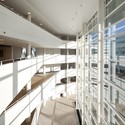
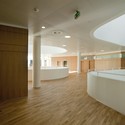
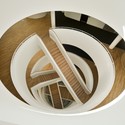
Inside, the building appears light and open with a flexible structure encouraging informal meetings and knowledge sharing. The dynamic atmosphere is intensified by the complex and innovative exterior expression.

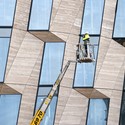
A unique façade design was developed in order to set new standards within sustainable solutions. The three dimensional façade in fiberglass and travertine works as a screen against the sun while still providing a view to the water. In this way, the architecture itself is actually the main contributor to the energy savings of the building.

© Adam Mørk

© Adam Mørk

Shape which saves energy

From the start, the objective was to design a building that didn’t just live up to the existing energy saving requirements, but that set new standards in surpassing these environmental regulations in the building code.

In order to shield against overheating, it was necessary to design the building in such a way that it is closed to the south and opened to the north. Because of the three dimensional relief, the facade works as a screen against the sun, thus allowing a pleasant office temperature. This is done while still providing a view to the water with each office having its own individually framed ‘bow’.

© Adam Mørk

© Adam Mørk

In other words, it is the architecture itself that has contributed most to energy savings in this building; the building’s orienta- tion and the facade’s three-dimensional self shielding design.

New Materials

With its unique design, the facade is also unique in its material composition. To adapt to the special geometry, it was natural to design using new and innovative building materials and methods.

© Adam Mørk

© Adam Mørk

If the same facade was to be built using traditional construction methods (ie. steel frames), it would be a challenge to build each element separately and therefore difficult to keep uniformity. By contrast, by taking the decision to build completely out of fibre- glass, it becomes possible to mass produce with much fewer discrepancies amongst the various building elements.

- In our research, we found several relevant references to ships and windmills – but no building projects with self-supporting and insulating fibreglass elements, says Bo Boje Larsen, Architect and Partner in .

The production method using fibreglass has been well known in many capacities, which allows for accurate projections and the know-how to actually design with it. The ‘innovation’ has been integrating fibreglass into building design.

The end result is a facade design which consists of two layers of fibreglass composite, with a highly insulated core of foam; upon which is placed an outer layer of travertine.

© Adam Mørk

© Adam Mørk

Optimal Design

In order to keep within the budget, it was necessary to design a facade with as many repetitions as possible without losing the unique expression of the building. Making the floor slab design zig-zag shaped allows for a very rational and efficient way of attaching the facade. In addition, by making optimal use of the moulds, it is made possible to realize the complex geometry without compromising the original architectural vision.

- Two years of research and development doesn’t really feel like hard work when we begin to see the results take form. The hardest challenges have actually been the most fun. In fact, it is these challenges that enrich the experience of an architect, says Olaf Kunert, an Architect on the project at 3XN.


Thumb up Thumb down 0
Balkan says:

simple and very impressive! Nice work

 
# December 16, 2009 at 13:17
Thumb up Thumb down 0
erik says:

I wouldn’t want to have those slanted windows in my office… think I’d get vertigo. Otherwise, a really interesting project – nice facade, and great materials.

 
# December 16, 2009 at 13:45
Thumb up Thumb down 0
Tosh says:

I like the windows though they do look dizzy and I don’t quite understand how the facade actually works environmentally – I get what you tried to achieve, but I don’t understand how you achieved it..

Otherwise – I love Copenhagen, Architecture of the North is ABSOLUTELY FASCINATING :)

 
# December 16, 2009 at 13:52
Thumb up Thumb down 0
Hampton says:

At some point these very interesting building skins become terribly inefficient, in terms of what you enclose versus how much you end up paying for it. Compared to the much more boring ‘developer-driven’ offices in the USA, these buildings begin to look like the silver-plated luxury-cars custom made for oil sheiks. I understand it looks cool, and people ought to be able to spend their money as they see fit. I’m just pointing out how some things we perceive as being so cool are really so wasteful.

 
# December 16, 2009 at 14:12
    Thumb up Thumb down 0
    BeRightBack says:

    @Hampton…. for real, dude? Why oh why would you take the time to read AND post on a website like this with an attitude like that?

     
    # December 16, 2009 at 18:30
      Thumb up Thumb down 0
      Hampton says:

      I’m not sure what you take my attitude to be – I’m attempting to be cordial and professional. I find the project fascinating formally, and I do know the difference between construction and architecture. I’m not arguing that the cheapest solution is always the right answer. I’m simply posing the question: Aren’t some of these facades so monetarily exorbitant when you could have many really wonderful designs for alot less?

       
      # December 17, 2009 at 10:18
    Thumb up Thumb down 0
    critique says:

    There is a difference between ‘construction’ and ‘architecture’. Architecture has elements of design for ‘delight’ in the built form, in the aesthetic, the materiality and the space that is created. Construction is all about achieving the cheapest and fastest possible built form to satisfy the function, without overly compromising the quality. There is no ‘delight’ in the built form, there is no ‘architecture.

    Your comment puzzles me on an architecture website.

     
    # December 16, 2009 at 19:35
      Thumb up Thumb down 0
      DS says:

      I think its a great comment and a good discussion to have. Cost is one of the prime considerations in architecture, and is often a central factor (if the the ruling factor) that steers the selection of the correct solution.

      Though I love to browse this site, many of the projects featured here are of little relevance to my professional career, where most of my clients don’t have the funds for such elaborate designs.

      Its refreshing to hear someone ask if we can do more with less.

       
      # December 17, 2009 at 12:12
Thumb up Thumb down 0
Max says:

critique’s attitude really puzzles me.. as it is rather defeatist. once you draw a hard line between architecture and construction, as artificial as that differentiation might be, you disenfranchise yourself from the global building culture.

and seriously… there’s more to “delight” than just the creation of architectural space. I think your definition of it is too limited. is there i.e. no delight in getting something done that fulfills its purpose – on time and on a (minimal) budget? I’d see “delight” in that, too.

 
# December 18, 2009 at 09:54
Thumb up Thumb down 0

10:21 PM Dec 16th

Check out: "Horten Headquarters / 3XN | ArchDaily"( http://twitthis.com/5z5bb7 )

Thumb up Thumb down 0

2:18 AM Dec 17th

Horten Headquarters / 3XN | ArchDaily – http://shar.es/aDppP

Thumb up Thumb down 0

4:17 AM Dec 17th

Horten Headquarters / 3XN http://bit.ly/6LphCl Superbe escalier!

Thumb up Thumb down 0

10:29 AM May 13th

Reading: "Horten Headquarters / 3XN | ArchDaily"( http://twitthis.com/5z5bb7 )

Thumb up Thumb down 0

6:40 PM Sep 11th

Horten Headquarters / 3XN | ArchDaily http://t.co/HDwr68b via @archdaily

Thumb up Thumb down 0

6:40 PM Sep 11th

Horten Headquarters / 3XN | ArchDaily http://t.co/HDwr68b via @archdaily

Leave a Reply »


Latest Comments »

“By focusing his lens on the lesser known cities,...[+]
I am proud of this project realized. Arief Budiman, whether you are an...[+]
love the feel of the studio plumbing-in-denver.com[+]
I came[+]
don’t take it so seriously…The ARCHITECT said,”Architects...[+]

Upcoming Architecture Events »

got events? invite us! click here

Architecture Books & Magazines »

London Unfurled / Matteo Pericoli

London Unfurled / Matteo Pericoli

If you haven’t finished all your holiday shopping, and you need something for someone who loves both architecture and London then we might have the right gift for you. We recently received Matteo Pericoli’s London Unfurled. This accordion-style book folds out…


After Crisis

After Crisis

“‘After Crisis’ concentrates around the new conditions for architectural practice and around the new epistemologies that may inform it in the next future. That is, in the period after the financial bubble has collapsed and living and working conditions


Passive Solar Architecture / David A. Bainbridge and Ken Haggard

Passive Solar Architecture / David A. Bainbridge and Ken Haggard

David Bainbridge, founder of the Passive Solar Institute, recently sent us his book Passive Solar Architecture. The book is a great introduction for anyone interested in passive solar architecture. The content is kept simple and straightforward. It allows any…


Our partners »

AD on iPad via Pulse

Browse by date »

Browse by category »

Friends »