
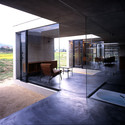
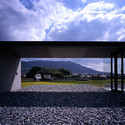
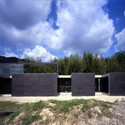
House in Gohara / Suppose Design Office
Architects: Suppose Design Office
Location: Kure city, Hiroshima, Japan
Program: Private House
Site area: 451.18 sqm
Building area: 109.43 sqm
Total floor area: 110.55 sqm
Photographs: Toshiyuki Yano from Nacasa&Partners Inc.
House in Gohara is a house of a young couple.
When I visited this site at first, I thought that I wanted to take the blessed environment of the neighborhood as much as possible.
And, to make the nature in order to stand out the building, it is composed of few materials as much as possible.
Then, it is neither a partition nor fittings among each part in the interior space. It composes- as the exterior space partitions the interior space.
By becoming familiar relation between the interior space and the exterior, and we could reach the new relation that it is not one space, it is not some parts of spaces either. We hope to become the place for architecture as a simple matter to enjoy nature using neither a special material nor the technology.
- first floor plan
- second floor plan


am i wrong, or the only way you get the view is sitting on the toilet!?!?!?
jesus…
i´m probably outdated with the new housing style from japan
woo… he’s right… jajaja
awesome!!! go suppose go!!!!!
The garage is upstairs, isn’t it? I kind of need a section of the ground to understand that, cause there are windows downstairs. I don’t know, lack of information.
the building is offset from the road… there is kind of bridge in the architecture connecting the road to the roof… that’s why u find windows on the the side of the road too.
see:
- Go01 image ( look on the very left)
- on the second floor plan, u’ll find the extended platform on plan
So cold! I don’t feel connected to nature at all in this design. I can imagine seeing that beautiful view and then cracking my head open when I walk though the glass wall. The photos really don’t help the architect’s argument at all
IDEA: House in Gohara / Suppose Design Office | ArchDaily – http://shar.es/apBnf http://bit.ly/n2cD5
nice, but a really introvert building in a really extrovert surrounding – even with the whole facede transparent, it could work – and maybe much better.
I could imagine it in a much denser enviroment.
The grass is definitely greener on the other side.
Looks like a lot of thermical deperditions to, in the end, feel like you’re in one big room.
Rodrigo Bocater’s comment is the best! hahha
eu realmente não entendo as conformações dos espaços internos orientais. admiro muito, mas diversas vezes chega a ser curioso o porque em decisões como essa nesse projeto!
vi seu blog! braileira/francesa! otimo! gostei dos textos =D
Ah, que bacana! Seja bemvindo!
When I saw teh 1st pic, I thought the wiew should be ugly or something. That happens a lot in japanese architecture, to hide from the external landscape of crowded urban towns. But nope: here the site is rather nice. Go figure…
energy waste, no privacy, Space one two and three are one visually, Too silhouette for…no nice view, more expensive construction, stones in the garage are beautiful in the photo, but I can^t see a woman walking with stylus shoes on them,
I think the majority of houses are currently undertaking to see from outside, as these monstrous women operated with botox, but no to living in. sorry for my comments.
Somebody once said here in Archdaily that modern japanese is for people who doesn´t need colours or plants or life because it´s all in their minds, or something like that. I still prefer these elements FOR REAL.
Real good work! I wish there were more photos…
to anavic,
the building is offset from the road… there is kind of bridge in the architecture connecting the road to the roof… that’s why u find windows on the the side of the road too.
see:
- Go01 image ( look on the very left)
- on the second floor plan, u’ll find the extended platform on plan
cool design. one have certainly to adapt the daily life to such sculptural designs – would be worth it for me. but i see a lot of potential termic problems. what about the climate-chenge?? projects not reflecting those problems are outdated, i`m afraid.
this house is joy for neighbors :-).
very ascetic, cold and conceptual house; maybe too much for the Europeans eyes. But for Japanese it’s – O.K. In some case, it’s like architectural haiku.
很喜欢建筑带来的这种宁静的感觉!!!
Anyone got any info on this building besides the whats on arch daily??
Cant seem to find anything anywhere!!! i am studying this building in college at the moment… emailed suppose office designs and they never got back to me :(
what if you are not nudist and you want to visit?!
There’s a lot missing compositionally, fenomenologically. The garage story needs some support-point or weight. And the living story seems too elementary, too.
But if this is for japanese, then who knows.
there are some who get very disturbed/ agitated when others do some very reasonable criticism about the cliched bare-concrete-with-puncture-marks look and the bare-cold-impersonal — and in some cases downright gloomy and morose — look and feel of many houses that have come to characterize what goes by the name of “Japanese Architecture” nowadays. and they talk of “different culture” and “Jap aesthetics”, and “the Japanese mind” and what not. I wish people had not bluffed themselves so much.
for example, see the Fisher’s Island House by Thomas Phifer (New York). same kind of minimalism, even the same kind of transparency and openness — with actually more glass then this house. same simplicity and unclutterred look. but completely different feel. you feel light and cheery. you feel “spring” instead of “winter”. you feel “tranquility” instead of “silent gloom”. for other examples of what minimalism and simplicity can and should be, compare the Ordos Villa with the Plus House (same basic concept), or even the traditional Jap timber-and-bamboo houses before this bunch of modern Jap architects came along.
who has ever proved that “simple” is the same as “bland”? that there is the opposite of “gaudiness” or “tackiness” has to be “cold” and “morose” but cannot be a golden mean in between? are these architects doing justice to even the traditional Japanese way of living and sense of beauty? a big NO, if “Japanese Architecture” has to mean building bare blue-gray concrete boxes or metal boxes — sometimes with non-right angles and skewed edges, and no demarkation between a living room and a bathroom. sorry.
oops sorry … not ordos villa, I meant the Osler House (Brazil).
what is the external cladding used?
There is a lot to be said of the ‘honesty’ within traditional Japanese architecture – this example is not one of them. As usual with most things Japanese, the idea is lost in the perverse separation of reality and ideology. Concrete can be a beautiful material to use, if designed, detailed, poured and finished correctly – and it does speak of many historic qualities of Japanese architecture (see, wabi-sabi, shibui, mono-no-aware etc.). think of it as liquid stone, without the time required to make it as such – stone. However, its the innate nature of contemporary Japanese architects who derive much of their enthusiasm from the ‘different’ for ‘difference sake’, which is rather pointless, there is no reference to begin to understand of question the design and building on. and yes, the practicality of ‘living’ in the space will be uncomfortable (taking a crap in full view of all occupants and passerby’s …) to say the least. It appears that most well-grounded, enthusiastic and inventive examples of Japanese architecture occur in the built-up cities of Tokyo, Osaka or Kobe.
7:38 PM Oct 27th
House in Gohara / Suppose Design Office | ArchDaily – http://shar.es/apBnf
2:41 PM Sep 23rd
House in Gohara / Suppose Design Office | ArchDaily http://www.archdaily.com/?p=38791