
Student House / Peter Gunawan

Uploaded by — Filed under: Housing ,Selected , ,
 

1253030227-1

Architect: Peter Gunawan Design Studio /
Location: Karawaci Tangerang ,
Client: Private
Stuctural Consultant: Junaedi Masil & Associates / Junaedi Masil
Contractor: PT.BMR / Nyoto
Photographs : Syaiful Boen

This dormitory house at Taman Permata Millenium, Lippo Karawaci, situated on a 375 sqm land in a currently urbanized area, is one of the many others with similar typology dotting the area to provide rentable one-person residential spaces. What separates this one from the other is what its spatial design offers to the inhabitants.

The facades give the building an echo of contemporary architectural forms, a “minimalistic style” if you like, with boxy masses balanced into a smaller, vertical and more introverted one, with a larger, horizontal and more extroverted one. Despite the careful planning of the exterior, the main feature lies in its interior spatial planning.

1253030234-2

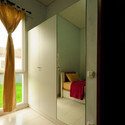
Viewed simply as temporary nesting space for students and working singles, the building typology usually bears keywords such as efficiency, economicaly built, low operational cost, giving it somewhat the industrial spirit lacking humane aspects, delivering common images of dim-lit corridors, minimum living space, and mechanized ventilation. Not with this one. Still bearing efficiency and economy to its realisation, the design aims to reject such typical gloomy myth by delivering reasonably measured inner spaces, natural light and ventilation as much as possible.

1253030238-3

1253030244-3a

1253030247-3b

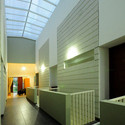
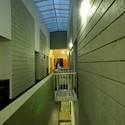
Density requirement and the constraint of the given land parcel demands the dormitory to be a multi-storey building, while efficiency directs the floor plans to have linear outline fitted with double-loaded central corridor with vertical circulation at both ends. Breaking away from usual attitude of wall-to-wall building, the architect pulled the sides away from the site edges, providing enough gaps for natural light and vetilation to nearly every units. A central linear skylight provides lighting for central corridors, while the corridors themselves are graciously spaced with 2.5 m spatial width. To allow natural light penetration into lower corridor, the upper one was designed with 1×3.5 m of floor openings, regularly distanced at the eastern part with glass blocks serves as bridging where functional access requires floor surface to exist.

floor plans

floor plans

section 01

section 01

1253030250-4

1253030256-5

At both ends of central corridors are common functions such as dining/sitting rooms, pantry, storages, laundry, and guest reception, with the front part equiped with outdoor terrace on the upper floor, giving an expression of lightness and simplicity to the front facade.

section 02

section 02

The central skylight, a sheet of heat-filtering translucent material placed along the roof ridge, requires no ceiling above the upper corridor, delivering a lofty space. Series of openings along the skylight allows the warmer interior air to climb and escape, creating updraft air movement as generator of natural air circulation, allowing AC units to be limited in the dormitory units only. Both natural lighting & air ventilation/circulation arguably contribute to the lower operation cost of this dormitory building.

1253030259-6


Thumb up Thumb down 0

The skylight is a very nice and in this case functional detail. Simple and to the point architecture, it is required sometimes. Cool.

 
# September 21, 2009 at 16:00
Thumb up Thumb down 0
Mommy Chiqa says:

Great design… !

 
# September 22, 2009 at 03:17
Thumb up Thumb down 0
Naim Ahmed Kibria says:

I don’t like the corridor inside, boring…no life, no freedom, like a jail. As you say the main feature lies in its interior spatial planning– i think it is better to announce the building a hotel for short staying. Take a room, sleep and leave.

 
# September 22, 2009 at 05:32
Thumb up Thumb down 0

Hi thanks for the response , this design just trying to be as honest to what it’s stakeholder need. any design input would be highly appreciated…

BTW there’s a person using my name on posting above me , hopes the admin can do someting about theis

 
# September 22, 2009 at 14:19
Thumb up Thumb down 0
sjaiful boen says:

Great Design Peter…!!! i really enjoy to take all of your designs..have a good concept, details, colors, specially you knows how to use a perfect materials; its just fit with the purpos n fuction of the room or building. Congratulations..!!

 
# September 22, 2009 at 21:17
Thumb up Thumb down 0
Husen Halim says:

Cool design, and having personality integration in concept.
congrat !!

 
# September 25, 2009 at 21:21
Thumb up Thumb down 0
Kristian Ong says:

Great design…. Congratulations!!

 
# September 27, 2009 at 21:07
Thumb up Thumb down 0
ren says:

First of all,I agree with what Naim Ahmed Kibria said. The hallway is boring and feels like a jail. It seems you are trying to separate each room to create maximum privacy. But is it possible when you are living in a shared apartment? How would the students interact with each other? Are they going to ignore each other when as they pass one another? I don’t know anything about the stakeholders, but should architects follow what they want? I think we know the answer to that. We’re not contractors or drafters. We are the one who decide these design. Also, what’s with the orange light? That really threw me away and makes this building to give the feeling of neo-classical buildings ripped off of their ridiculous useless decorations. This is nothing more than a copy of minimalism buildings by people who don’t know its theory.

 
# March 29, 2010 at 19:15
Thumb up Thumb down 0
Angel says:

if I may suggest, the corridor as a void is useful to direct wind flow into the building if there is enough opening on opposite sides. And if what you said to get natural sunlight perhaps you want to have a clear vertical void and not being obstructed by the upper floor pathway or else you would only get 1.75m wide light input on lower floor, if you know what I mean. Bridges are fine though. And I agree that the corridor looks like a concrete bunker. The material you used for it looks too heavy and depressing for only 2.5m wide yet long corridor. You might want to consider material alternatives and put seating for students interacting there or else it would look like a ‘dead’ passageway where people just want to pass it quickly to their dens.
Hope it’s useful:)

 
# January 25, 2011 at 04:51
Thumb up Thumb down 0
Hery says:

Hey it’s cool design !!
everyday i cross along this house..

 
# November 4, 2011 at 05:57
Thumb up Thumb down 0

2:01 PM Dec 14th

http://www.archdaily.com/35248/student-house-peter-gunawan/ –> klo kos2an ada yg kyk gini trus murah, aku pindah sekarang jg!!!

Leave a Reply »


Latest Comments »

Simplicity and complexity in the same place: composite functionality...[+]
why shall this happen again? the 70′ are back in town (do we...[+]
seem like Osler Hous by kogan marcio[+]
i came for the comments[+]
Lovely. I like the mystical quality of the light. Though,...[+]

Upcoming Architecture Events »

got events? invite us! click here

Architecture Books & Magazines »

Volume 27: Aging

Volume 27: Aging

I never can get enough of Volume. This issue is loaded with provocative articles that stimulate discussion about a pressing reality, the dramatic demographic shift in the age of human populations. Throughout this issue there are articles like Martti…


Strategy Space / a+t: Landscape Urbanism Strategies

Strategy Space / a+t: Landscape Urbanism Strategies

Landscape Urbanism is the new black in architecture and this magazine, part of a+t strategy series, has heads turning. There are a dozen projects and hundreds of ideas in this edition. A recurring them is the manipulation of time…


The Architecture of Croce, Aflalo and Gasperini / Aflalo and Gasperini Architects

The Architecture of Croce, Aflalo and Gasperini / Aflalo and Gasperini Architects

Aflalo & Gasperini Arquitetos recently shared with us the book they are launching titled, “The Architecture of Croce, Aflalo and Gasperini.” The book details the 50 years history of one of the most important architecture office in Brazil. The…


Our partners »

AD on iPad via Pulse

Browse by date »

Browse by category »

Friends »