





-
Architects: Strauss-Solid-Ritter
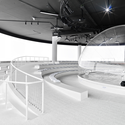
Text description provided by the architects. The Austria Pavilion designed by Strauss-Solid-Ritter for the Expo Zaragoza 2008 was an extension of the popular 19th-century “cyclorama” art form. The viewer platform in the center of the panorama and the plastically designed historic panorama architecture in the foreground merge into a white landscape marked by contour lines, which will serve as the pavilion’s exhibition space. This abstracted landscape (i.e., exhibition space) forms the center of the various “panorama spaces” that result from the changing projections, while its abstracted form ensures that the landscape is also an integral part of each projected panorama. For example, when surrounded by images of mountain tops, the landscape transforms into a mountain crest; and when the images change to trees, the landscape becomes a green forest clearing.

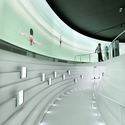
The landscape’s modeling interplays with the mirror’s doubling effect to create diversified spatial and viewing relationships: Some spaces will be “completed” by the mirror’s reflection (Arena), some spaces will provide an ideal overview of the landscape and panorama (Plateau), and still others will not be doubled by the mirror (hollowed path).

Visitors will thus experience the pavilion as a sequence of “staged spaces” having different dimensions. After entering the cave-like foyer, one must ascend the path to become aware that the space gradually opens up. Having reached the top, or Plateau, the space broadens fully to reveal the spectacular panorama views.

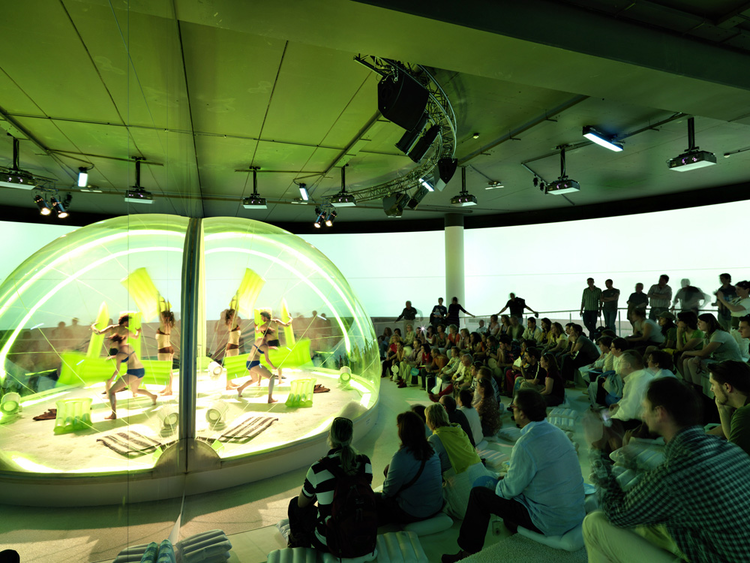
On the Plateau, visitors become a part of the staged scenery, or veritable actors within the panorama, including the ability to walk amidst the abstracted landscape and to view their reflected image. This integrative element of space, landscape and viewer is also present in the design of the pavilion’s façade, as well as in the performances held inside. Ultimately, integrating the works of selected artists, such as Tomas Eller and liquid.loft, will lead to a multifaceted dialectic between art and architecture.


