




-
Architects: Guerin & Pedroza Architectes
- Area: 10000 m²
- Year: 2008
Text description provided by the architects. Reclaiming the urban space
In 2003, the agency Guérin & Pedroza was put in charge by the City of Toulouse of renovating and restructuring an area of 10,000 sqm which houses a shopping arcade and underground parking spaces. This complex, designed at the end of the 1970s, extends from the middle of a block of buildings dating from the previous decade located in a historical neighborhood to the heart of the old city. Since 1990, degradations had been increasing in number, and shops were unable to stem the decline in the number of people visiting them. A recurrent problem with which numerous shopping centers are confronted in France. For Guérin & Pedroza, the challenge consisted, on the one hand, in bringing this immense space crossed by two pedestrian ways (east-west and north-south) back to life and on the other, in making the shopping arcade more attractive and open to its immediate environment. The site and its connections with the neighborhood needed to be more alluring.

‘This project comes within the scope of our reflection on revitalizing city centers and promoting existing structures', explains Hector Pedroza.

Breathing life into an area
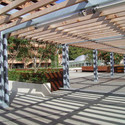
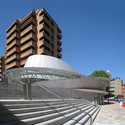
Offering passers-by clear reference points is the principal watchword. A large stairway is an invitation to discover the place Occitane. There, a rhythm is set up by variations in the treatment of vegetables and minerals. The space is divided into several sectors: pergola, grove, esplanade, campo, recreation area, carpet, lane. Each is set off from the other by the choice of materials, lighting and species. A diagonal lane, articulated by vegetable columns, makes the major axis stand out by joining the main two entries. Contrary to the monotony and cold minerals of the area dating from the 1970s, the new landscaped place is given over to plantations: cherry trees, jasmine, box trees, laurel, myrtle, lavender, santolina, soapberry tree.

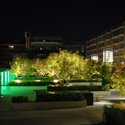
In the middle of the esplanade, the concentration of trees is more dense, hinting at an interval of relaxation. The variety of materials used for treating the ground and urban furniture contributes to livening up the place: concrete, marble, granite, duckboard, pergola and benches, rusted steel for the tree planters, brushed stainless steel for the fences of the atrium of the gallery. Lamps lay out paths and create a climate that invites nocturnal strollers to take this way with confidence: candelabras, suspended lighting, lighting of vegetable columns and of the pergola.

Setting up a commercial arcade in the city
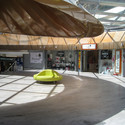
Three entries with direct access from the street open onto the Espace Saint-Georges. A volume composed of two elliptical aluminum cones and a glass roof, beckoning the city towards the main entry into the shopping centre. On the other side of the space, a door topped with a large copper awning offers a view across the arcade. The ground, which is paved along a few meters, merges into the roadway. The shopping centre extends over two levels: a transition and, lower down, the arcade. This intermediate level makes it possible to situate the entries at street level in order to link up with pedestrian traffic. As a sort of appeal, the shop windows integrate the Espace Saint-Georges into the buildings facing the street.

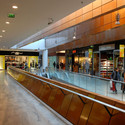
The mall is lit by natural light thanks to four lighting wells. Passers-by remain in touch with the city, which is visible behind the windows. The light penetrates down to the lowest basement, thanks in particular to the large glass roof that lights the atrium, a space for vertical circulation. A vegetable wall serves as a reference point and accompanies customers up to the parking area.

The itineraries are simplified: a principal axis and a circulation loop. On the ground, the bright marble reflects the daylight and the light from the signs. The aluminum wall covering, silver on the outside, takes on a copper tint on the inside - a subtle reminder of the bricks of Toulouse.

By designing this commercial arcade as a place for strolling, extending the pedestrian circuit of the neighborhood, the architects are attempting to find anew the spirit and dynamism of covered passages from times gone by.


.jpg?1392821175)


