
Vitra Children Workshop / Alejandro Aravena Architects

Uploaded by — Filed under: Retail ,Selected , , ,
 

080828_vitra_02-copy

Architects: Alejandro Aravena
Location: Zurich,
Project team: + Ricardo Torrejón + Víctor Oddó
Partner Architects in Germany: Osolin Plüss
Models: Ricardo Torrejón
Built Area: 600 sqm
Project: 2008
Renders: Víctor Oddó

Also, Alejandro Aravena shared with us the Sketchup model that you can download here

sketchup model

A thing, not an object.

It’s been a couple of years now, since I heard Argentinean architect Rafael Iglesia describe one of his projects as the attempt to produce a thing not an object. A thing, he said, does not have project, it has not been designed; but an object has.

I might have misunderstood what he meant, but I translated it as the difference between a chair and a stone. A chair is designed to be able to sit on it. A stone, if of the right size and form, may allow to sit on it, but was not designed as such. A thing has a life on its own, it has no purpose; only circumstances, e.i. use, make a thing become intentional.

080828_vitra_07

Even though it might seem a paradox, the idea of designing a building as if it has not been designed remained in my mind. I wanted to achieve the status of those cases that are closer to nature than to artifice, even though they are obviously manmade, cases in which the consecutives layers of knowledge applied to a given question and the uninterrupted trial and error approach besieging a problem, have shaped answers efficiently and smoothly. Some archaic shoes, some antique vases or some primitive tools have erased the traces of their formation process up to the point of acquiring the capacity to fit life, naturally.

The VITRA job seemed from the very beginning to be the case to do a thing not an object, something as natural and statement-free as a stone, but if of the appropriate size and form, able to perform as a building, in this case as a children workshop.

No ideas, but facts

The first meeting took place in November 2007, on site: an existing garage neighboring Siza’s factory and Hadid’s firestation, that had been recently added to the Weil am Rhein Campus property. Rolf Felhbaum began by saying, as if it was a very normal thing, that he wanted a “direct” building for hosting the workshops that VITRA offers to children as an extra curricular activity. He did not say simple, nor cheap, but direct. It was one of the healthiest and most strategic starts I have ever had. Looking back, that first requirement, became the frame that defined the tone of the discussion and oriented the decisions that were taken afterwards.

080828_vitra_06-copy

In part due to the remoteness (Chile-Switzerland), in part because it just happened that way, we started a “thinking-out-loud” type of process: an Internet dialogue in the form of texts and drawings where very clear, common sense, pragmatic options were evaluated. It was an exchange of facts, not ideas. Ideas are overrated.

Do we keep the garage and adapt it for the workshops? Being the building just a collection of small additions not flexible enough for an easy reuse, and being the environmental standard of the construction very poor, insufficient for an educational facility and very costly for a simple upgrade, what appeared to be more reasonable, was to demolish the existing structure.

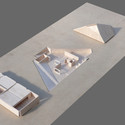
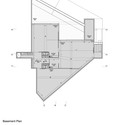
However, to keep the 400 m2 underground made a lot of sense. So, the footprint of the basement, dictated the shape of the building on top.

basement floor plan

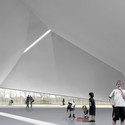
Do we integrate the basement by perforating the slab? To remove some earth and get rid of a peripheral wall to bring light, air and people through a sloped courtyard, was easier.

How do we prepare the initial building to grow afterwards and still make sense? We thought that a fence was more flexible for future developments than a building. We spent a lot of time trying to balance a shape and size for the fence with the maximum space for the workshops but the minimum impact in the context in order to let Hadid’s building be visible from the street.

The long distance dialogue was followed by regular face to face meetings with Rolf Fehlbaum and the VITRA crew, where key, very precise and fresh conditions and orientations were given:

Use encouraging materials. Not rough, low budget, but encouraging materials.

corte-aa-2_3d_der_m

Do a happy building. Think of an environmentally friendly eventually recyclable structure. Discipline the form.

That is how we arrived to the wood and the reet as materials for the building. Form follows facts: The thatch roof follows archaic rules, taken from a time when construction and environment were not an option nor a technique but a fact as natural as gravity. The wood is laid in a way that structural intuition more than calculus informs its form.

Since we cannot compress the time required for an object become a thing, we decided to integrate as many layers of accumulated knowledge as possible, replacing experimentation by synthesis.


Thumb up Thumb down 0
nothing to say says:

I usually like Aravena’s work. But I don’t know if I like this giant pita bread.

 
# July 9, 2009 at 08:12
    Thumb up Thumb down 0
    Lehung says:

    i’m sure with you, this place is not for children.

     
    # July 9, 2009 at 11:35
Thumb up Thumb down 0
neoinc. says:

very nice “thing”… seems to be a great composition somewhere between an object and what aravena interpreted as HIS “thing”. the orthogonal struktures are well integrated in the dominant hut-form…

i like the aravena stuff very much so this nice project undergirts my opinion of his creative mind and output…

well done, mr. aravena, and it seems to be affordable too…

neo.

 
# July 9, 2009 at 08:21
Thumb up Thumb down 0
neoinc. says:

@ nothing:

hehe, giant pita bread is a kinky association, but i’m a bit with you.
i see it as a so called “reet-dach” (german), that would be very interesting i guess.
reet is a natural material, made of the stems of bulrushes…
it guarantees a great inner climate and would fit to aravena’s regional basic approach.

links for “reet-dach”:

http://www.reetdachdeckung.de/uploads/pics/reetdach.jpg

http://www.dachdecker.de/zvdhaktuell/webdocs3/upload/Reetdach_2_05032007092245.jpg

neo.

 
# July 9, 2009 at 08:29
Thumb up Thumb down 0
PanamArq says:

very nice, i like the interior space but I keep being drawn to the nose-picker

 
# July 9, 2009 at 09:04
Thumb up Thumb down 0
Hellyess says:

i agree with comment #1. I really like Aravena’s work, and begin a south american, i always show his new work to my colleagues, etc. But this one.. i don’t know. Not good, not good.

 
# July 9, 2009 at 09:23
    Thumb up Thumb down 0
    neoinc. says:

    are there any reasons for sayin’ : not good, not good??? or easily not good, not good?

    neo.

     
    # July 9, 2009 at 09:28
Thumb up Thumb down 0
Arturo López says:

it looks like a childhood memory,
not even “a thing”
a thought

 
# July 9, 2009 at 10:16
Thumb up Thumb down 0
16:08:78 says:

One can trace Aravena’s failure in this project easily with his statement: “So, the footprint of the basement, dictated the shape of the building on top”….…really,…. I though he said Form Follows Fact?….. Then how the basement got that shape in the first place? What does that shape follows? I’m sure there must be an argument that addresses this issue, but the fact is it is not stated here.

In the interesting pursue “to produce a thing not an object” Aravena fail. As far as I’m concern this still is an object.

 
# July 9, 2009 at 10:34
Thumb up Thumb down 0
mathias says:

It is a very interesting goal that Aravena tries to reach with his theory of the “thing” vs. the object.Unfortunately, and despite the fact that his building is carefuly and masterfuly designed it does not reach the status he aims for. This is a good example of the great distances that often separate theory and practice. It is never easy to materialise abstraction without the natural flaws and limits of savoir-faire.

 
# July 9, 2009 at 11:32
Thumb up Thumb down 0
Comitant says:

If you want Thing, not Object, then the only really option is stereotomic. Andy Goldsworthy’s Rivers and Tides would a good source for understanding the difference.

Carve away, dig, scoop, rebuild, but always with the same matter: rocks, mud, clay, sand, reeds, reshaped and reformed until they become usable and inhabitable.

I can see the intent in the rendering, of the accidental roof covering, as if some giant walked by and left his hat and that became the space. But everyone, including children, know this is a building designed and built. The accidental look is just a look. Looking at the section, I bet this roof Object will effectively be a highly engineered tectonic construct.

Theoretical considerations aside, the building looks like fun. But why not make the surface of the roof somehow usable? With an exposed tectonic solution, kids could play in the rafters and have little windows that peer out of the thatch. Tiny attic spaces looking out would be great fun for kids.

 
# July 9, 2009 at 12:46
Thumb up Thumb down 0
rek says:

i understand the object trying to be a thing, or at least looking that way, i saw the interview in canal13 cable,”la belleza de pensar”, and mabye there´s where aravena is going, BUT, in my opinion, if you are “compiting” with the other works at the vitra campus, you should try harder…

 
# July 9, 2009 at 15:10
Thumb up Thumb down 0
rek says:

and understanding what building on that campus means, eaven harder…

 
# July 9, 2009 at 15:13
Thumb up Thumb down 0
sisifo says:

i dont know. aravena was my first architecture teacher… i can say he is like an idol to me, love the books, the projects. but … judging for the images and the model , my veredict on vitra´s project is : FAIL!…

 
# July 9, 2009 at 22:38
Thumb up Thumb down 0
medusa says:

The world of furniture design is madly in love with the Campana brothers. Weird hybrids between plastic and rattan. Teddy bears woven together by shantytowns artisans. There seems to be a need of fresh views, with the enhanced creativity that the lack of means tend to force. Milan gets expensive chairs with a latin soul, Vitra gets the ‘arte povera’ provocation of a thatch roof in the middle of a signature campus.
On a recent interview the painter David Hockney, when caught contradicting himself, said ‘never listen to what the artist says, look what the artist does’. One might not believe too much the clever and provoking words that come with the project. We will just have to wait to see what really matters… how the building will actually be.

 
# July 10, 2009 at 17:05
Thumb up Thumb down 0

6:37 AM Jul 9th

RT @archdaily: Vitra Children Workshop / Alejandro Aravena Architects http://bit.ly/NhICT

Thumb up Thumb down 0

6:38 AM Jul 9th

#architecture Vitra Children Workshop / Alejandro Aravena Architects:
Architects: Alejandro Araven.. http://bit.ly/EZAsB

Thumb up Thumb down 0

6:56 AM Jul 9th

Vitra Children Workshop / Alejandro Aravena Architects:
Architects: Alejandro Aravena Location: Zurich, Switzer.. http://bit.ly/EZAsB

Thumb up Thumb down 0

8:02 AM Jul 9th

Reading ArchDaily Vitra Children Workshop: http://bit.ly/Te1N9 – Thoughtful design process for freeform addition to existing building

Thumb up Thumb down 0

9:39 AM Jul 9th

Reading: “Vitra Children Workshop / Alejandro Aravena Architects | ArchDaily” (http://twitthis.com/a3fp7w)

Thumb up Thumb down 0

7:53 PM Jul 9th

ArchDaily – Vitra Children Workshop / Alejandro Aravena Architects http://bit.ly/16O4RD Also, Alejandro Aravena shared with us the Sketc …

Thumb up Thumb down 0

8:21 AM Jul 10th

Revisando el Vitra Children Workshop de Aravena http://bit.ly/eOrsS

Leave a Reply »


Latest Comments »

nice!!!! very vogue and stylish! i’d love to have my teeth pulled...[+]
Does the architecture world like the tent I pitched?[+]
the future is now[+]
im sure you are not biased…MOHSEN![+]
im sure you are not biased MOHSEN![+]

Upcoming Architecture Events »

got events? invite us! click here

Architecture Books & Magazines »

Guide to Contemporary New York City Architecture / John Hill

Guide to Contemporary New York City Architecture / John Hill

If you want a brief simple city guide of contemporary architecture in New York City you can have a look at our city guide, but if you want a thorough guide book then you should check out John Hill’s Guide to…


Call for Submissions – CLOG: Rendering Issue

Call for Submissions – CLOG: Rendering Issue

 We have been following the rising popularity of CLOG, beginning with their inaugural thematic issue on BIG and, their second issue on Apple which highlighted Jobs’  Apple Campus 2 in Cupertino by Foster + Partners.  This latest architectural publication seeks…


MARK Magazine #35

MARK Magazine #35

As you well know already we love MARK Magazine, and this issue fails to disappoint. It has projects from many of the architects we have featured here on ArchDaily such as, StudioGreenBlue, Heri&Salli, Clavel Arquitectos, Kengo Kuma, Colboc Franzen, Studio Velocity, Takeshi Hosaka, Fuhrimann Hachler, Toyo Ito, Nieto Sobejano, L3P Architekten,…


Our partners »

AD on iPad via Pulse

Browse by date »

Browse by category »

Friends »