
Support on the -- Click here to nominate us for Best Online Magazine!Close
Follow us on twitter! twitter.com/archdaily

Museum of Luz / Pedro Pacheco + Marie Clément

By Nico Saieh — Filed under: Museums and Libraries , Selected , , , ,
 

Architects: Pedro Pacheco + Marie Clément
Location: Luz, Mourão, Portugal
Programme: Museum
Constructed Area: 660 sqm
Budget: US $ 1,555,000.00
Collaborators: Sara Antunes, Pedro Rogado
Museology: Benjamim Pereira
Engineering: G.O.P. – gabinete de Organização e Projectos, Lda.
Lighting engeneering: Raul Serafim
Client: E.D.I.A. – Empresa de Desemvolvimento e Infra-estruturas do Alqueva, S.A.
Project year: 1998-2000
Construction year: 2000-2003
Photographs: FG+SG - Fernando Guerra, Sergio Guerra & Paulo Nunes Silva

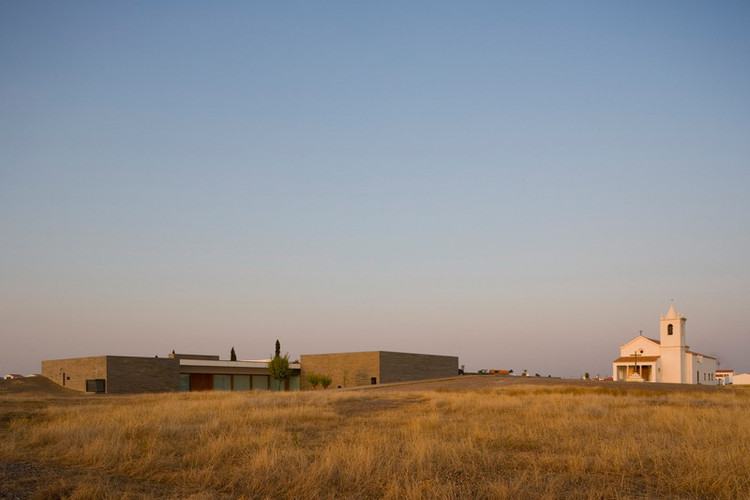
Luz is the name of a small village in the south of Portugal, with 300 inhabitants. Due to the Alqueva’s Dam construction, the Luz village was submersed. Its inhabitants as well as its culture and origins, had to be dislocated into a new village. The intervention program consisted in creating a new place for the reconstructed church, the new cemetery and the Luz museum as an important memory landmark between the new and the old village.

The aldeia da Luz dislocation is a replacement act, a double and simultaneous act of destruction and foundation. In this double process of landscape transformation, the old village remains as a conceptual embryo – one first nature elaborated through centuries of territory appropriation and a second nature thought and built as a new identity.

The foundation of this new place, aims to absorb, in a new topographic and geographic situation, analogies to the old church’s place – the church and the cemetery as strong identity elements and the museum as a founding element of the new place, endowed with the representative notion of replacement.

The village dismantling process brings back to surface various signs, such archaeological, as anthropologic, historic and architectonic, which embrace not only the village but a whole territory as well. The museum allows storing, classifying and communicating such information, being the result of the whole process of substitution, which, apart from the physical presence, establishes an intentional complicity between the two villages situation.

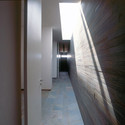
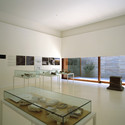
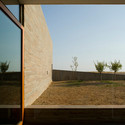
The strategically location along the East-West axe, brings forward its structural character. Building a museum out of schist relates it more to earth, to stone soil and to the idea of foundation. The museum redesigns the topography of the place in a telluric relation with the landscape, reflecting the building as an identity mark, where the paths, the walls and the light, turn evident elements of a territory construction culture. This reading is completed by a sequence of interior spaces with singular character – atrium, multiuse room, temporary exhibition room, memory room, Luz* room and patio – witch emphasize a particular regard over landscape.

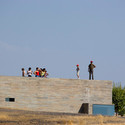
In a rural atmosphere where technique emerges from the matter manipulation, the use of material and local traditions approach the building act to a natural process of landscape constructing. The 50cm thickness double concrete and schist walls, extracted from a local quarry 3 km far, determined the space atmosphere of the museum and increment the thermo inertia of the building.

Luz room, as the central museum’s figure, constitutes along with the light chimneys the only visible trace of the building in the landscape. It is a space of light, a white page prepared to receive the writing of the Luz territory history being transformed.


27 comments »

os says:

Ist Zumthor!

 
# June 3, 2009 at 00:39
3D says:

Simply Beautyful!

 
# June 3, 2009 at 01:27
christos says:

it doesn’t matter if it is Zumthor, it is still beautiful and well done to the architects.

 
# June 3, 2009 at 02:02
JuanLuisBurke says:

It is a very nice building and it blends so well with the landscape. Great handling of the materials and the details are quite well executed it seems.

 
# June 3, 2009 at 10:44
JuanLuisBurke says:

It is a very nice building and it blends so well with the beautiful landscape. Great handling of the materials and the details are quite well executed it seems.

 
# June 3, 2009 at 10:46
tchouah says:

Great mastery of the fondamentals architectonicals elements : context, materials, luz, sequences, fonctions.
reaching that goal with more complex projects is tuff

 
# June 3, 2009 at 11:57
julio says:

omg!! Zumthor doesn’t copyright the stone masonry, in that line i suppouse he also copyright the timber. LOL .
Beautiful Project.

 
# June 3, 2009 at 12:02
George says:

in line with the previous comments, I think the approach to the landscape and the way in which the landscape and building interact/meet are what sets it apart…really well done. I really like how quietly it sits on the site and in the context of this location…

…of course with light like that, its hard to go wrong!

 
# June 3, 2009 at 12:42
Kate says:

OMG another beautiful work in Portugal… What’s goin’ on there?

 
# June 3, 2009 at 14:09
Lucas Gray says:

Great integration with the surroundings, great materials, great detailing and just a purely elegant design. How did they get away with having an accessible roof without railings though?

 
# June 3, 2009 at 16:41
    marie Clément says:

    Portugal!

     
    # July 22, 2009 at 11:26

Wonderful building. I like the monolithic walls set into the ground, which are just the right colour for the location.

 
# June 4, 2009 at 10:24
rodrigo says:

Few people work the details as Portuguese architects.
Excellent work!!

 
# June 4, 2009 at 10:48
Bo Lucky says:

Submissive approach – way to design while placing value to the big picture first. This is missing from soooo many contemporary projects. Personally I doubt if the grass stays brownish all year round to harmonize with the building color scheme but even with green around, I am sure the building looks great in its setting. Very elegant design by a sensitive architect for a sensitive community (have you noticed – there is no single “skyscraper” to spoil the town skyline?).

 
# June 4, 2009 at 10:55
aem says:

it has nothing to do with zumthor but it’s very nice.

 
# June 4, 2009 at 11:14
Opium says:

Pobrezinhos mas honrados,né filho??? It’s scary to think that this is really very good and specially in comparisson to a lot of the stuff presented everyday in this site and still these is not a top firm in portugal…indeed i would say in football terms they fight to avoid relegation. it really shows that portuguese architecture is top of tops on world level today. If only we had more money…oh god…then we could really some shitty scrappers…lol

 
# June 4, 2009 at 13:37
Robert says:

Great building. For those near London in the near future there is an exhibition at the RIBA called Overlappings: Six Portuguese Architecture Studios. It includes Aires Mateus. Bak Gordon, Bugio .Joao Favila, Ines Lobo. Paulo David and RCJV. http://www.boidus.co.uk/?p=1075

Like the project above all the project seem very grounded in there place and use materials of a high quality. Is this the norm in Portugal? My personal favourite is the Arts Centre in Funchal by Paulo David.

 
# June 4, 2009 at 16:03
Robert says:

In response to Opium. I was discussing Architecture is Portugal with an attendee of the RIBA exhibition. He was saying how difficult it is for young practices to emerge in Portugal due to the fact that anayone can design a building. Is this the case? Is a lack of regulation of the profession the problem?

 
# June 4, 2009 at 16:05
Opium says:

The situation here is paradoxal Robert. On one side as i said earlier we have probably the best architectural schools(speacially in Porto)and on top of that we have world class act like Siza.On the other side we have had a long time debater over a law that permits non architects(civil engeneers for example)to sign architectural projects. The consequences of that are that lots of the construction in portugal,namely housing,iludes architects.But i must say this has gradually changed and now promoters see that bringing a good architect into their speculative projects can earn them more respect and money. If was to say what the real problem for young architects here in portugal i would say that is their excessive number making their wages very low or even non existing. The older allready estabilished architects take advantage of this cheap labour and they use the portuguese architectural syndicate to promote this policy.

 
# June 4, 2009 at 16:25
Opium says:

As for the first question yes…it’s norm in portugal. We take enormous respect for the landscape we’re operating in. It’s something that has grown with years and that different architects express in different ways but yes i would clearly say that’s the portuguese trademark the same way the dutch show that almost child like optimism…i guess we’re a bit more sceptikal and more low key.

 
# June 4, 2009 at 16:31
roadkill says:

Poignient, beautiful, meaningful and well detailed… the rest of us should take note and learn a thing or two with projects like this instead of being critical over precedents and what inspires them….

 
# June 5, 2009 at 07:13
Lianne says:

It is a beautiful building which manages to combine the past and the present in harmony.

 
# June 5, 2009 at 08:19
Durban says:

The photographer certainly earned his money. I wonder if the real experience of the space would be as vivid and elegant as the images.

 
# June 5, 2009 at 10:16
roadkill says:

Durban, I agree the photography is exquisite but let me reassure you that this part of Portugal is stunning and experiencing it in the flesh is 1000x more powerful than you can experience with a photo and the landscape surrounding it makes this project look stand out even more – as it was said before its a complementary relationship between building and landscape

 
# June 5, 2009 at 16:24
Robert says:

Yes I agree with Roadkill. A photo is just a still representation of a much more lively scene. I am now very tempted to see this building. What are your tips for visiting this area?

 
# June 6, 2009 at 07:12
roadkill says:

Well Robert… this is in the south of the country; far enough from the Algarve and the larger cities but you will need some wheels or else the most hidden gems will be out of reach. Don’t go in the peak of summer or you will cook [temperatures exceed 40 degrees c] but accommodation although not easy to find is very reasonably priced but you may prefer stay in the Evora and make the drive there… or even stay in the neighbouring Spanish cities – it’s just across the border

 
# June 6, 2009 at 12:06
Emanuel Sancho says:

“relationship between building and landscape… ”
“photographer certainly earned his money…”
“beautiful building which manages to combine the past and the present in harmony.”
“Poignient, beautiful, meaningful and well detailed… ”
“the way in which the landscape and building interact/meet are… ”
etc, etc, etc…

I enterely agree. I love the piece of art. I love the spaces.
I certainelly will visit it as soon as I can.

As a museologist I ask about the people of Luz. Do they USE their museum often? Does the museum fullfils their needs? Do they like it? Does the museum play un important roll in their daily life?

Emanuel Sancho

 
# June 7, 2009 at 04:37

Leave a Reply »

Want to have your own avatar? Get yours at Gravatar.

Latest Comments »

What basic rules of the eye perspective?[+]
I liked much this project… It’s true that...[+]
This is certainly a mixture of styles but somehow it feels quite...[+]
What an innovative, unique yet modest project this...[+]
you are a true knower of contemporary architecture, i...[+]
i actually quite like it! because the material was kept...[+]
l.a. w.e.a f.e.a[+]
Why waste space by not giving it to people?[+]
At least you would add some...[+]
A linear plan that works. Access to full...[+]
i’m with mr.cheap on this one, this largely reminds me of a much less...[+]
Can somebody get into the web page? 406 Not...[+]

Browse by category »

Our partners »

Browse by date »

Friends »

Proudly hosted at »