We made it to the top 5 contenders! support and vote us for Best Online Magazine at the Open Web Awards! [close]
Have you seen our interviews in High Definition?

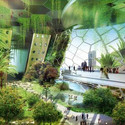
Dragonfly Vertical Farm concept by Vincent Callebaut

By Karen Cilento — Filed under: News , Skyscrapers , Sustainability , Urban Design , , , ,
 

Amidst financial buildings and high-rise apartments, Belgian architect Vincent Callebaut has redefined the conventional skyscraper. His 132 story complex for the south edge of Roosevelt Island addresses the pressing need for environmental and ecological sustainability. This conceptual design focuses on creating a completely self-sustaining organism that not only utilizes solar, wind, and water energies, but also addresses the pending food shortage problem.

More after the break.

The mixed programs in Callebaut’s Dragonfly are centered around two main towers. These symmetrically arranged towers allow growth to expand vertically rather than horizontally to account for the crowded Manhattan conditions. A sprawling greenhouse links the two towers and helps carry the load of the building. The complex is arranged in a way that housing units and work offices are interspersed between meadows and farms.

The metal and glass wings, directly inspired by the exoskeleton of a dragonfly, house the plant and animal farms. Due to the appropriate sun and wind conditions within these wings, proper soil nutrient levels can be achieved to maximize plant growth. Exterior vertical gardens filter rain water, and once that water is mixed with domestic liquid waste, both are treated organically in order to be reused for farming needs.

The space between the wings accumulates warm air from the exoskeleton to heat the complex during the winter, while natural ventilation teamed with plant evapo-perspiration will cool the air during the summer.

Callebaut imagines the occupants of the Dragonfly caring for its vast fields, thus allowing each user the opportunity to make the complex a success. Although Dubai seems like the perfect place for such an experiment, Callebaut has not given up hope that New Yorkers can also pave the way during this sustainable era.

Seen at Designboom.


67 comments »

D. says:

ugly…

 
# May 23, 2009 at 11:30
zn says:

unificient.let’s keep farms horizontal

 
# May 23, 2009 at 11:35
Fino says:

So left field……I really wouldn’t know how to conjure up any kind of criticism. I’ll let someone else take a whack at this one. haha

that is all.

 
# May 23, 2009 at 11:38
Balkan says:

On first view I thought it is another Dubai. From outside it is very ugly but in last 2 interior views I could say that I find some positive stuff.

 
# May 23, 2009 at 11:46
dustin says:

Why would we ever need this? What is the deal with these new vertical urban farms? I can see this happening one day on the moon but there is no need for it here, like zn said, lets keep farms horizontal, in the country where they belong. Just the cost of the megastructure hardly seems sustainable, and produce already losses 50% of its nutritional value when farmed grown. Now imagine the consecuences of taking plants completly out of there natural enviroment = disaster waiting to happen.

 
# May 23, 2009 at 11:53
dustin says:

cool images though.

 
# May 23, 2009 at 11:54
MJ says:

3dsMax+Photoshop work = 5/10
brain work = 1/10

enough said.

 
# May 23, 2009 at 11:55
kc says:

dragonfly wings are very beautiful, but why this project does not look as inspiring. whenever I start to read about all these natural cycles like in some science magazine, it’s putting me to sleep and meanwhile the techies gone green wild do not care about the actual architecture – as always is the case. First you try to take over nature, then you try to take over architecture, everything that has a human soul attached to it, and DELete. If I really wanted sustainable living I’d leave the city and try to develop a plot of land without mechanized means – and I know how hard it is. I do not see sacrifice in this building.

 
# May 23, 2009 at 12:13
PB says:

I have to see, I’ve seen similar ideas before that were better worked out. However, I think everyone who’s left criticism so far has missed the point. Vertical or tower farming is a potential method that would reduce the impact of large urban areas, such as NYC, on the state and national infrastructure, while also providing local production of food (something not readily available in NYC). As megalopolises continue to grow, they push production farming further and further from the center of the city. In a era where we car easily expect the transportation of foodstuffs to grow dramatically in cost, we need to find more inventive ways of providing cost effective food. Locally produced food also decreases the carbon impact of food production and consumption.

that said-I think this design is a little much. I like the concept and I think the stripped down model isn’t bad looking, but I think the size, scale and massing needs to be reworked-this is the chunkiest dragonfly I’ve ever seen.

Best of luck in reworking the design.

 
# May 23, 2009 at 12:57
David Cacho says:

I’m exploring my self the movement of architecture towards a living organism, and I’m glad to see others do the same, but I vomit my lungs when I see unconscious decisions been made by so called “green architects” that need a “green” building on their contemporary portfolio just to validate themselves as one. But how can you know how to identify these guys? Trough their work. And what do they reveal trough their work? Their thinking. So you guess when you see an interior render with views to the exterior, like for instance the last one on this project, would you agree to use the same unsustainable design pattern of using cliché wood floors, and furniture, that for some reason give the impression of been recycle from another project. Well may be there lies the real “green” part of the project…. // Puerto Rico.

 
# May 23, 2009 at 13:05
mm says:

When I see a project like this (project with grand scale and nice renderings that ussualy jump out of reality) on this website, I always find at least 5 comments about how it’s ugly.
Those comments speak only about people that posted it, and nothing about the real critics. People here are ussualy architects, and I can’t believe they can satisfy themselves with a comments about prettiness of the object. Did anybody really think about it’s main function – vertical farm! Why? Because we don’t have enough space on this planet, we need projects like these.
——
MJ says:

3dsMax+Photoshop work = 5/10
brain work = 1/10

enough said.
——

MJ didn’t even think about objects functions and why is that form, only about renders, which can tell much, but much more is in the text, which wasn’t read, obviously…

Anyway, I think that projekt is nice conceptualy, and opens a lot of discussions about building programs like this.

Please, it doesn’t matter if the building is ugly or pretty, but is it smart or stupid?

 
# May 23, 2009 at 13:13
:] says:

Que diabo é isso!?

Não respeita a escala da cidade. Desproporcional e estranho ao entorno…

 
# May 23, 2009 at 13:22
Nom_de_Guerre says:

Eco-Design FAIL

 
# May 23, 2009 at 13:22
walter faulk says:

looks familar….Romses’s winning submission for the Formshift competition looks alot like this one.

 
# May 23, 2009 at 13:37
Fino says:

@mm

I agree, but I think a smart building should not be an alienating one. Right now, this projects seems extremely aggressive and intentionally self righteous.

 
# May 23, 2009 at 13:46
tzaar says:

tough shit- it is ugly, and it means that we can’t actually engage the program and intentions because it is so wildly self indulgent. seriously, these are very impressive renderings but the amount of time that went into them is so much more than the thought that went into them. what is that giant chrome fillet on the outside edge of this building? lazy!

but as far as the farms go- I would need to see a little more analysis. How many people can this thing feed? What is the cost/benefit analysis? do you REALLY expect the people that live here to tend the fields? And these renderings of the farms… please. How does one tend the vines growing from the ceiling? How can you justify the massive amount of public/generic strolling space through the gardens.

I want to love projects like this. I want to embrace them, but good lord, think about what you’re doing before you put in all of this effort.

and what is this even made of?
form has consequence!

 
# May 23, 2009 at 14:13
charles says:

until a farm in new york can economically justify the square footage it takes up, in comparison to a financial office, brokerage firm, hell even an architecture firm, concepts like this cant be anything more than concepts.

in the meantime, it seems alot more feasible to try and integrate vegetation and farming into an existing building type. there are great examples of roof gardens that are doing this nicely, though also inefficiently.

 
# May 23, 2009 at 14:22
dustin says:

@mm
“Please, it doesn’t matter if the building is ugly or pretty, but is it smart or stupid?”
basic principles of architecture: firmitas, utilitas, VENUSTAS. Yes mm, it does matter if a building is ugly or pretty, it’s called Aesthetics and it is one of the most important parts of Architecture or any other art. A building that has a great structure and function is not complete without it’s good looks.
I am not saying this is an ugly building. I am saying you are wrong if you think aesthetics are not important. become an engineer. Or an accountant.
Is this a smart building? what is a stupid building?

 
# May 23, 2009 at 14:58
thiago says:

I think mr. callebaut is a marketing genius… apart of his designs – sometimes ok, sometimes great – he have really nice way to present it, sell himself to the big public. At least here in Brazil, the last 2 “architectures” that received any media publishing was his lillypad city and that tower that turns in itself, I forgot the name of the architect.
About his designs, I think he is always the 2nd to propose, I mean, he can’t come with anything really new, but he does it in a nice and beautiful way, showing himself… maybe in the future he will get some real job to do and we can see if he’s good enough.
I really like this approach of marketing. At least he is being honest.

 
# May 23, 2009 at 14:59
@ says:

As a student I work with lots of people who adore radical formalism. It is all well and good when there is some deconstructivist philosophical backing, but that is a rare case. People are too caught up trying to be the next Frank Gehry and not concerned with producing good architecture. I would not describe myself as a functionalist but, to a certain extent the form must serve a purpose, and making allusions to dragonflies as a green model is not the way to do it. A building can make allusions but one hit wonders of ideas like this aren’t good. Gehry’s fish are successful because they do things not because they look like fish, that’s just a playful part of it. This project seems all too serious about it and is far far too literal. So on behalf of myself, my fellow students, and the future of the profession, please for the love of god stop spitting out things like this and focus on innovations in program and actual design, vertical farming is great, whats the next step? Til you can provide a design to answer that question in a way that both embraces and challenges society stay away from metaphorical allusions and annoyingly literal designs because they encourage bad designs in students.

 
# May 23, 2009 at 15:12
jr says:

please dont make NY like ¨dubai crap/joke architecture¨

 
# May 23, 2009 at 15:20
dustin says:

Another thought. Since when is architecture a universal product? Why is it possible to make the same building in Dubai and NewYork? Where is the context study? Climate study? Guess what… Dubai is a desert.. this is supposed to be a green, sustainable building? Give me a break. This is happening occasionally in Architecture now of days, the rotating building is another example. Where is this profession going?

 
# May 23, 2009 at 15:26
bamboozaal says:

to thiago

You mentioned that he is always ‘2nd’
I suppose you are referring to Lilypad (which looks so much like BIG/PLOT’s ‘MER’ project)
or his ‘Perfumed Jungle’ (which is eerily similar to Mass Studies’ Soeul Commune)
If you take away ripped off concepts from others, brilliant renderings by Pixelab what are you left with??
Well you nailed it in your first line – marketing
There isn’t much else

 
# May 23, 2009 at 15:33
Fran says:

Is Caillebaut an architect ?
What is his motivation ?

His works reminds me some utopist work of architect that were actually constructing buildings in the same time.

When finally Caillebaut will build something, he’ll be very disappointed

 
# May 23, 2009 at 15:53
Nick says:

Conceptual and academic. Don’t worry

 
# May 23, 2009 at 15:58
Bo Lucky says:

Evaluation of a project as per a private set of principles (e.g. sense of personal taste or needs) is always subjective and without explaining what criteria were used, it has no value at all. Aesthetics is also very subjective – therefore, as long as principles applied by a reviewer are unknown, it really does not matter what a critique says. It is important whether a building is functionally comfortable, visually harmonious with its surroundings (since I personally do not agree with those who are shaping Dubai), and (to a degree) user friendly. I like this dragonfly building the same way I like a nicely designed book cover and if somebody else likes it, it only means that we share a similar sense of beauty… but who cares if we like it or not if we do not exactly define why. To provide a constructive feedback, a set of “measurable” criteria must be applied to a specific areas of the assessed project, then a result could be more concrete and useful. Otherwise we can only talk, and talk, and talk, and talk… though… there may be a purpose in talking too…

 
# May 23, 2009 at 16:40
kevin says:

loving nick´s comment ! ;)

 
# May 23, 2009 at 17:11
joe shmo says:

awesome building love it!

 
# May 23, 2009 at 18:38
tom says:

this building is simply the ugliest thing i have seen!

 
# May 23, 2009 at 18:51
eee says:

uuuuuhhhh….Ahhhhhhh….Another peace of intellectual BS!!!! something gotta change with this whole modern “green” architecture crap…

 
# May 23, 2009 at 18:54
16:08:78 says:

Noah’s Ark 2.0

 
# May 23, 2009 at 19:09
Opium says:

Who’s scared of this new green facism raise your hand…anybody? Is it just me or this whole topic of sustainbility is being pushed much more by speculative commercial interest than real envirommental concerns.Good Architecture as always tried to be as sustainable.This whole concept of the so called green architecture is most cases pure propaganda to sell projects.Environment is an important issue for sure but this green architecture,well ilustrated by this awfull project,focus it self in high tech and extremely expensive construction techniques and materials to develop very poorly conceived buildings that ignore all the rest that architecture stands for…integration with the site,respect for history and even artistry. Haussmann destroyed half medieval paris for supposed higienic reasons, i’m guessing that sooner than later some other haussman will destroy our cities to make them greener.

 
# May 23, 2009 at 21:05
kc says:

Opium,
Yeah I’m really sceptical about it too, I think it also is an excuse for non-designers to advocate themselves as architecturally righteous and make extra money as well. It is becoming a way of controlling architecture. I just find it really boring at least and annoying at the most, because there is much more to architecture than just ’sustaining’. But in reality it will develop into a huge industry resulting in more faceless projects. Those who can’t design, usually stick with the green because it can substitute ideas. And yes, good architecture is usually sustainable by default, especially before the society became subservient totechnology. There is just something wrong in the sustainable movement in architecture; it’s not a bad thing but I find it’s somehow not addressed right.

 
# May 23, 2009 at 21:41
Optimus says:

Dragonfly or butterfly ?
whatever, the insect would break NY’s landscape.

 
# May 23, 2009 at 21:43
zach says:

LAME. GOING GREEN DOESN’T HAVE TO BE UGLY AS HELL

 
# May 24, 2009 at 00:22
thiago says:

bamboozaal – you understood my point, as an architect, i don’t know, but sure he is a good marketing guy..

Bo Lucky – great comments, may I use in the next discussion? haha

Opium, kc – I disagree with “good architecture is always sustainable”, I think it’s a new way of understanding the world, so answering to questions never asked before… but I think green, as it has been sold now, is far from green or truly sustainable, that’s what we need to fight for, a truly holistic building that understands what is and how should behave in a sustainable society, and not just because it has grass on the walls or is shaped like a young butterfly…

 
# May 24, 2009 at 00:31
gx says:

fugly. enough said. dont wanna know anything more about this. thank you

 
# May 24, 2009 at 02:13
MJ says:

@MM

“MJ didn’t even think about objects functions and why is that form, only about renders, which can tell much, but much more is in the text, which wasn’t read, obviously…”

C’mon MM.. you can’t be that stupid! or did you miss the ‘brain work = 1/10 part’?

 
# May 24, 2009 at 05:30
mm says:

Now these posts are nice, much better then yesterday, sorry MJ for taking your post as an example, but actually, you didn’t have any real comment on the building, everyone can just say ‘brain work = 1/10 part’ without any explenation, and I agree about aesthetics, it’s just that my sense for that is mostly based on my opinions and taste, and not so much on facts… But, I’m glad people realy have posted good comments here…

 
# May 24, 2009 at 06:01
Stone says:

Terrible……

 
# May 24, 2009 at 08:54
MJ says:

Why would I (or anyone else!) waste my time on such a bad project? I’m already saying too much!

 
# May 24, 2009 at 10:38
ThePete says:

Do any of you naysayers understand how food gets to our plates? Because it seems like you don’t.

It takes a lot of oil to create gas that powers trucks to bring this food into our fair city. A LOT of oil which creates a LOT of pollution. OH and because food comes from so far away, we pay more to get it to where we are.

The solution? Have a farm here in NYC so the food can be grown and sold locally. Of course, we have no farmland here, but if we farm vertically, we can make it work. This is basic logic–as a New Yorker myself, I don’t give a crap about what the skyline looks like if I can have inexpensive, healthy food that, by buying it, allows me to support my local community.

Is this guy’s design perfect? No design could ever be. But is it a reasonable alternative to paying more money for food to be trucked in? I’d say yes. Don’t like it? Don’t live here.

 
# May 24, 2009 at 19:21
Katsudon says:

So may we call it an ugly interesting concept?

 
# May 24, 2009 at 19:39
ThePete says:

Haha, I’ll allow it!

Sorry, I didn’t mean to come across like such a dick–I agree it completely crashes with the skyline and don’t blame anyone for calling it ugly. I look at it and think “what the hell is that?”

How often do you get to say that about a building? (Whether it’s bad or good?)

 
# May 24, 2009 at 19:56
ThePete says:

sorry should be *clashes

 
# May 24, 2009 at 19:56
rain says:

starcraft

 
# May 24, 2009 at 20:39
Rupesh says:

whats the point in creating a problem and then trying to solve it….terrible…whats the scale of this in its surrounding ??…this seems just for the sake of it….

 
# May 24, 2009 at 22:28
Ammar Kalo says:

Absolutely horrible..
Horrid..
Horrendous..

why do “green” buildings always have to have plants crawling all over the place, and why do they look ugly 90% of the time?

 
# May 24, 2009 at 23:40
ThePete says:

All right, well, I tried to explain the other side. Guess it’s more fun to just cut stuff down than it is to be hopeful. You guys would have been a big help during the space race.

“Ugly spaceship.”

“Why do we need to go to the moon? WTF?”

And to Opium, who is scared of this “new” green fascism–really? You think the environment is fascist? Upset that oxygen forces itself into your lungs? Would you rather put it to a vote as to whether or not your body is made up of mostly water or something else less oppressive?

There’s nothing I can say at this point that won’t sound extremely dickish, so I’ll just move on.

 
# May 25, 2009 at 00:29
dustin says:

“There’s nothing I can say at this point that won’t sound extremely dickish, so I’ll just move on.”

- Please do

 
# May 25, 2009 at 00:54
j foss says:

A lot of haters here… I love this idea!

Sure, it’s a bit out there, but we need these conceptual models to start discussing real solutions. Urban agriculture is said solution and will be a much more prevalent in our discussions over the next decade. They’re beginning to prove that crops in controlled environments can increase their production by as much as 30 times that of traditional farming… this environment is much more efficient, no pesticides are needed, transportation is greatly reduced, it improves city’s air quality, and can have a biomass clean energy powerplant on site… the list goes on!

There are a lot of peops who are afraid of change and the comments here validate this… With business as usual building and infrastructure design, we’re not only putting off consequences.. we’re rushing towards them!

Try and practice a little less criticism… taking three seconds and glancing at a picture and commenting ‘fugly’ doesn’t really accomplish anything.

 
# May 25, 2009 at 10:41
francis says:

Definitely, with the price of real estate (even in the current downturn) as it is in major cities, ideas like this is a long way behind in the queue for ideas to improving our cities. The limitations, is not of technology and certainly not the lack of imagination, it is the sq.m + cost limit in realising any ambition. Green is still a false economy. Things will change; probably not in my lifetime, but I won’t discount it either.
Infrastructures have to improve first. They benefit everyone in more then just food deliveries.
Dependant ecological system – well, yes, when a key link fails, the whole system goes belly-up, catastrophe.
Food – perhaps we ought to just eat a little less? It’s our own mess, are we really that useless, and what’s the sense of having a giant guru butterfly coming to our aid? Maybe we ought to utilise our typing and commenting time more fruitfully?

 
# May 25, 2009 at 12:05
Bo Lucky says:

“Maybe we ought to utilise our typing and commenting time more fruitfully?”
MAYBE????

 
# May 25, 2009 at 12:15
Lucas Gray says:

The hypothetical vertical farm was tackled by MVRDV years ago. The concept isn’t new, the design is not aesthetically pleasing (and I’m not ashamed to criticize the look of a building) and there is no way this is sustainable. As for overcrowding…I don’t think farms are the reason we are lacking land. Its overpopulation that is the problem. Use the money it would cost to build this building to buy crates of condoms for every man in the world and we would be a lot closer to a sustainable society.

 
# May 25, 2009 at 13:42
bak says:

too much to say, i suddenly became speechless..damn!

 
# May 25, 2009 at 16:24
Benjamin says:

At first sight I thought it was horrendous. But looking at it again, you could get some really cool views and spaces connecting NYC with Roosevelt Island. However this project tries to portray a complete fake image of what sustainability is. How many resources will you invest in building a structure like that? Totally unsustainable. A pretty dream?

 
# May 25, 2009 at 22:40
Benjamin says:

Another thing…with all those animals, your building is going to smell like manure.

 
# May 25, 2009 at 22:48
dustin says:

Why not build vertical farms in the dying suburbs instead, make them useful… obviously a much more moderate proposal. That may be a good way to solve part of the suburbia problem.

 
# May 25, 2009 at 23:20
Ralph Kent says:

It’s funny, isn’t it, how most architects seem to believe Lord Rogers that ultra-high density is the solution, and therefore we need to bring ultra-high density food production into the cities to reduce food miles? Now, what if Lord Rogers was wrong in “Cities for a Small Planet”, and his model is only viable with a mindless, consumption, service-driven economy?

What if some other architects who propose smaller settlements, mixed economies of local food production, processing, manufacture might be on to something? In that case, we don’t need to reinvent the wheel. Nature has a good knack of doing things the most efficient, easiest way. Man does the opposite as a rule, particularly attention-seeking architects.

I despise how architects will flick through a coffee table book, see an image like a dragonfly wing and say ‘that is my inspiration’ with a cursory understanding of the mechanisms or biology at play. I am not a biologist, I don’t know anywhere near enough about the way that nature works to start citing it as the generator for my designs, and I suspect that is true for about 99% of all architects.

Urban high density does not need to be the answer, with everyone mindlessly shopping, working all hours to afford to shop more and contacting their ‘friends’ via myspace or facebook. There are other models. It would be good in what will inevitably become a post-consumer economy architects thinking more about how we WILL live, rather than trying to invent models to support a way of life which cannot be sustained.

One of the most inspirational books I have read on this is Cul Zuffel e l’aura dado. I would recommend you check it out if you’re lucky enough to have a copy in your library.

 
# May 26, 2009 at 03:44
francis says:

“MAYBE????” Bo looky it’s a fly of sort … definitely not bee! I’ll grant you that it is May.

 
# May 26, 2009 at 04:26
Hanna says:

Aaaaaaaaaa…!

 
# May 26, 2009 at 09:19
Gozilla architects says:

it looks like godzilla’s windsurf :-)

 
# May 27, 2009 at 04:28
Abdullah says:

Reminds me of immature projects I used to see in universities…
Being complicated in architecture isn’t good at all, keeps you too far away!
An architect is human after all and lives on earth.
It doesn’t mean that it’s good or bad, but better keep such ideas in the fantasy world.

 
# May 27, 2009 at 06:33
Moxikito says:

Err…..HHmmmm….. DragonFly wings are not like that!! they are thin and long.

That’s more a buterfly wing than anything else. If not a windsurf sail………

 
# May 27, 2009 at 08:27
ART.TREND says:

WTF ??? I HATE THAT !!!!

100% PHOTOSHOP
0% ARCHITECTURE

 
# June 2, 2009 at 14:48
Rose says:

The building is definitely awsome!!! However,how can it be ecological in any way?? In order this huge structure to be build nature is actually being destroyed and what we do is just replacing it.Cutting thousands of trees so as to plant the vertically??? And that’s what we call ecology nowadays!

 
# June 11, 2009 at 07:50

Links to this article »

Leave a Reply »

Want to have your own avatar? Get yours at Gravatar.

Latest Comments »

i love that...[+]
cool drawings![+]
the boxy shape on the side in the last image is the...[+]
Car insurance claims >> http://onlinecarinsuranceclaims.com/ on YAMoPo 2008: Yet Another Most Popular Architecture Sites Ranking:
...[+]
this is what we love her for stop agonizing...[+]
“the 12,000 sq m ceiling will be clad in Red Lauro...[+]
Very Google.[+]
wonderful project… would be great to have...[+]
Sustainability anyone?[+]
Moar! floating stair...[+]
I’m sorry to ask, but what are those urinal shaped things?[+]
Why do some supports have cushions ? Oh, and there is...[+]

Browse by category »

Our partners »

Browse by date »

Friends »

Proudly hosted at »