

Text description provided by the architects. Cornell University's new home for its Imogene Powers Johnson Center for Birds and Biodiversity is an 80,000 square-foot building and a one-of-a-kind facility attracting bird enthusiasts and the world's top avian researchers alike. With features such as the Macaulay Library of Natural Sounds, the world's largest collection of natural sounds containing 130,000 sound recordings covering 5,600 bird species, a DNA sequencing lab, and a museum-quality exhibit of Louis Agassiz Fuertes' wildlife paintings, this world-class facility was designed with scientists, tourists and birds, in mind.
"The Lab design is the result of six years of very hard work by a dedicated team," said Nicholas Garrison, project design architect. "Always, the key to the project was finding a way to make a very large building meld into and even enhance a delicate natural environment. As much as possible, this project was about trying to achieve the virtually impossible task of making a two acre building feel like the ingenious bird blinds that inspired the construction of the original lab on this site 50 years ago."

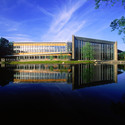
Working closely with the lab's ornithologists, the architects found a way to make it easy and inviting for people to see birds while at the same time ensuring that the building nestled into its natural site. The team's architectural challenge was to design a large multi-function building on a wetland site. The sloping and curving walls and roof forms gracefully place this building into the landscape.
The exterior of the facility is made to fit within Sapsucker Woods-a wooded bird sanctuary roughly three miles from Cornell's main campus in Ithaca, New York. Just two stories high, the lab stands below neighboring trees. Constructed of cedar wood and locally quarried Llenroc stone, the building's shape is abstractly "birdlike" and is the result of the desire to give everyone the best possible views of the sanctuary's beloved pond and the nearby woods. The plan's curves follow the pond's contours, narrowing to a collective "point" of entry that works to scale the building down and engage it with the sanctuary's nature trail system.

Engaging these nature trails provided the inspiration for the entire site and landscape design, developed by Boston landscape architect, Susan Childs. The lab is integrated into an expanded wetland landscape defined by small "islands" set in bio-filters and marshy swales. The visitor approaches the lab from a series of bridges and boardwalks through this naturalized environment.
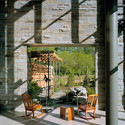
Upon entering the lab, visitors face a two-story wall of windows offering great views of the duck pond, with birds practically coming to their feet. Designers framed the windows, used curved glass, and created random patterns so that birds could detect the windows, while visitors inside could still watch the action outside.

Every step of the way, visitors have the opportunity to see and learn more about birds. Wooden chairs are set up throughout the lobby, with telescopes and binoculars available for those who want a closer look at the dozens of local avian species. Even the lobby carpet was chosen with the idea of the bird's natural environment in mind-its dark grey and gold pattern is reminiscent of looking through the forest at shadows of leaves and birds.
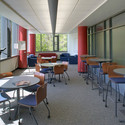
The offices and laboratories are designed using the colors of the New York State bird, the Eastern Bluebird. Laboratory floors are blue and office walls are white, blue and dark grey. Serendipitously, the school color of the university (nicknamed "The Big Red") is also found in the Eastern Bluebird, and is portrayed in the red linoleum marking the hallway to offices and on fabrics throughout. For those who work in the building year round, the bright colors also provide a warm and welcoming environment and contrast the often dull and grey Ithaca winters.