
San Pablo / URBANA

Uploaded by — Filed under: Houses ,Selected , , ,
 

Architects: URBANAJosé Fernando Vázquez-Pérez & Rafael Castro Montes de Oca
Location: Río Piedras, San Juan,
Project Team: Carlos Cruz-Ortiz, Luis Cruz de la Paz, Yalmari Tirado-López, Miguel Moreno
Contractor: Sharp Construction, S.E.
Electrical Engineering: Carlos Requena, PE, Requena & Asociados
Structural Engineering: Carlos Lázaro-León, PE, Lázaro & Gandía Consultores
Mechanical Engineering: Francisco Maté, PE, Maté & Asociados
Project year: 2007-2009
Photographs: José Fernando Vázquez-Pérez

Location/Context

The project is located in a mid-century development of Río Piedras [San Juan]. The neighborhood, typical of upper middle class housing developments of the time, is composed of lots averaging 1,500 m2, with individually designed custom houses. The house sits on a corner parcel, defined by a local main-street on the south-east, and by a cul-de-sac on the north side.

floor plan

Site/Zoning

The site is characterized by densely vegetated lots, dominated by large, older trees, and by a rising topography which flattens out on the northern side of the property. The zoning restrictions favor single-family, single-story occupancies.

Concept

Concept and Precedents - Spanish revival Courtyard typology

The residence, commissioned by a young family with two kids, initially started as a substantial remodeling-addition to a 1950′s house. But after the initial rehabilitation concepts proved economically unfeasible, it became a “new-house” project. The clients were particularly specific in describing their architectural intentions for the project: “…a structure that would evoke the clarity of mid-century Puertorrican modernism, with the charm and climatic responsiveness of their courtyarded, Moorish-styled, Old San Juan loft. Ironically, the initial design concept started by emulating the essence of the original house [as evidenced by the dominant horizontal rooflines, the use of ironwork as privacy/security/illumination screen, the location of the main structure installed on a pedestal, etc.]. Slowly, the project became one of reconsidering the “Spanish courtyard house” typology, itself an offspring of the Islamic influence on southern Spanish architecture, and an emblematic model of some of the early, native urbanización [development] projects in Puerto Rico like Villa Caparra, and Sagrado Corazón developments.

The neo-Islamic-modernist strategy played off a peripheral massing around a central patio and pool, with minimal perforations on the street side, and a gradual aperture from the interior towards the outside, similar to the Persian Iwan [a three-sided space, open on the fourth side, usually containing a water-feature] , and the Arabic Sahn [a courtyard]. The plot was conceptualized as a perfect square, divided into a 9-square grid, with a central void representing the patio; the grid was then expanded into a 16-square grid, with public, semi-public, and private massings, a central patio, an oasis [pool], a gazebo, and secondary yards, with a lateral multi-square sleeve for possible future expansion [the clients plan to purchase the north-side cul-de-sac from the city].

Concept and Precedents - Project Concept

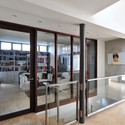
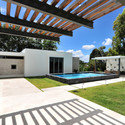
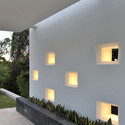
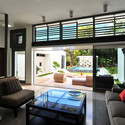
Architecturally, the resulting house is dominated by a main, squarish volume, defined by the massive, “floating” roof plane, and a series of lesser rectangular bodies that seem to protrude from the larger mass. The frontal façade also features a monumental, triangular Mashrabiya, or screen, which, like the modern brise soleil, or like the native rejas [ironwork], functions both for privacy and ventilation. The posterior façade also features a series of wooden brise soleils that modulate the interior-exterior transition on the rear, and help mitigate the entrance of sunlight. In terms of spatial organization, the larger, main volume houses the public spaces of the residence [living, dining, family room, kitchen], while the private rooms are mainly contained by a secondary, enclosed and partially solid bar-shape structure. The outdoor terrace, pool, and gazebo are conceptually punctured out of the massive, main volume, and are defined by a smaller floating roof, and perforated end wall.

Sustainable Features

In addition of taking advantage of natural cross-ventilation, the house features a green roof [on the main volume and gazebo], a rain-water recovery cistern, solar water-heaters, and a high efficiency air-conditioning system; the house was built using fly-ash [for walls and ceilings].


Thumb up Thumb down 0
ron brenner says:

This is a very nice piece of modern architecture, although i feel like the Precedents are a bit of a stretch. I am not sure I see the precedent in the new.

Simple,Unique, Creative and Green House Plans
Spreading the word on great home design

 
# April 3, 2009 at 10:41
Thumb up Thumb down 0
odris says:

That’s near my house!

 
# April 3, 2009 at 13:05
Thumb up Thumb down 0
Fino says:

Hm. There is something off about that diamond-screen. It seems heavyhanded,as oppossed to the other surfaces. Not well balanced, and possibly too conflicting. I honestly just want to reach through the photo and rip it off.

that is all.

 
# April 3, 2009 at 13:13
Thumb up Thumb down 0
Michael Nash says:

The precedents aren’t necessarily visual or aesthetic — they’re conceptual, functional, etc.

A beautiful modern take on mid-century-modern concepts.

 
# April 3, 2009 at 13:14
Thumb up Thumb down 0
kamran says:

hey
That is IRAN not IWAN

 
# April 4, 2009 at 02:24
    Thumb up Thumb down 0
    مهدی says:

    اتفاقا همون “ایوان” درسته ؛ ایوان ایرانی

     
    # October 27, 2009 at 07:43
Thumb up Thumb down 0
jlbr says:

I love the project, it’s a bit funny but it reminds me of the work of Puerto Rican architects Fuster and Partners. They had a house making headlines a couple of years ago. The Delpin-Núnez House:

http://www.fusterpartners.com/porfolio/casadelpin.htm

 
# April 4, 2009 at 13:49
Thumb up Thumb down 0
Terry Glenn Phipps says:

Kamran, Iwan is an architectural term, and it might be worth your time to look it up.

This is my second go at a comment about this house. The key here seems to be trying to build a bridge between inward looking typologies and the modernist tendency to embrace nature, views, and the outward world. It isn’t easy to do this because the layering of arabic, roman, etc. architecture is complex and goes to important notions about public and private lives.

To me this house is a partial success in bridging that divide and I really do applaud the ideas behind it and they it has been executed. The raised pool seems the most “medina-esque” feature of the building

The sense of place within the realm of the notional tropical modernism of Morris Lapidus or Paul Laszlo I find very successful and compelling. This was the “other” modernism of the twentieth century, the one that beckoned and lured without chastising and democratizing. On this level the house is wonderful an reminds me a bit of the work of Architectonica at their best.

Plaudits for building a great house that I am sure the owners love.

Terry Glenn Phipps

 
# April 5, 2009 at 04:47
Thumb up Thumb down 0
SHERVIN says:

Very Nice . . .

 
# April 5, 2009 at 06:11
Thumb up Thumb down 0
Rokas says:

As a “pure”,modernist building it seems a little bit “too much”-too much details,too heavy..As a modernist reflection of the old-the old had a pure fors,and a fantastic, very gentle, but overwhelming ornamentation.
So,its kind of missing both directions-its somewhere in the middle-neither bread,neither meat..

 
# April 6, 2009 at 07:00
Thumb up Thumb down 0
Sun&Associates says:

VERY GOOD APPROACH IN THIS HOUSE. IS GOOD TO SEE HOW IT TRANSLATE OLD STRATEGIES FROM THE EXQUISITE ISLAMIC ARCHITECTURE INTO A CONTEMPORARY SOLUTION, IN TERMS OF SPACES CREATED. THE INSIDE/OUTSIDE RELATIONSHIP DEMONSTRATE A METHODICAL COMPREHENSION OF THIS ENVIRONMENT. AND THE USE OF NATURAL LIGHT, SHOWS A CLEAR UNDERSTANDING OF THE ABUNDANCE OF LIGHT IN THE CARIBBEAN (HOW REAL IS THAT GREEN ROOF IN THE DRAWINGS?). IN OTHER HAND IS A SHAME TO SEE AN AESTHETIC RESULT SO HEAVY. ONE WOULD LIKE TO SEE MORE VERTICAL, OR LIGHTER ARTICULATION OF MATERIALS. WHEN YOU LOOK CAREFULLY THE SCREEN IN THE FRONT FACADE, WHICH IS MEANT TO BE A LIGHTER ELEMENT, DUE TO ITS FENESTRATION, IT SEEMS VERY HEAVY.

WITH THIS GOOD PRECEDENTS AND THIS GOOD UNDERSTANDING OF CLIENT-ENVIRONMENT RELATIONSHIP, ONE WOULD LIKE TO SEE SOMETHING THAT CAN ACTUALLY START TO BREAK THE COMMON MODERN-CUBISM, SO POPULAR IN PUERTO RICO, AND INSTEAD PROVIDE A CONTEMPORARY SOLUTION WHO RESPOND TO NEW TIMES NOT ONLY CLIENT WISE, BUT ALSO TO THE SPECTATOR IN THE OUTSIDE.

 
# April 7, 2009 at 12:51
Thumb up Thumb down 0
mdr says:

I think the work is great and it does, successfully, combine ornamentation with sleek-clean lines to achieve an interesting balance. More importantly, some ornamentation [wood screens i.e.] serves also as an instrument to filter natural light in spaces & hopefully ventilation, which unfortunately are frequently ignored in ‘tropical’ settings architectural designs.

Aside from the precedents, i think the patio is an overall a successful space in recognizing two important aspects of our context-past and present. Being from puerto rico, i know how pleasant an Old San Juan interior patio can be and, on the other hand, i also know that the typical house layout has transformed itself into a hermetic box that completely denies nature and its surroundings.

Knowing the work of this young team, this house is no exception of their ‘trademarks’ : lots of natural light and ventilation [which are not relative but crucial design aspects of all spaces], good space distribution and good eye for details.

 
# April 7, 2009 at 13:05
Thumb up Thumb down 0
Facundo says:

JLBR, agreed; it’s funny indeed! This fellow you’re refering to must be something! Like a Christopher Columbus of architecture down there (before him they were probably all Indians and look at them now with a bunch of projects in Archdaily and everything). Forget about Neutra, Klumb, Toro, Ferrer, Amaral, Marvel, Flores, Lapidus, Cardona, Mignucci; what did they do? Now, without that project you mention, they’d probably be living in huts still. Funny, funny!

 
# April 7, 2009 at 18:07
Thumb up Thumb down 0
m-avatar says:

I have never commented on Archdaily, but this project deserves some discussion. I agree with Terry Glenn in that it establishes a difficult premise to resolve (merging modernism sensibilities with Islamic symbolism while rethinking the suburban house typology). It does have something of the Lapidus spirit but it seems arranged in a more cerebral manner, even if one disagrees with its “styling” (I personally don’t mind the so called ornamentation, as I think the geometric patterning eloquently evidences some of its “eastern” intentions). A possible misappreciation of the project is that it’s trying to be a either a modern building or an historic one, when it seems that it consciously aims towards a particular hybridization. I actually live somewhat close to the Delpín house (a nice project, btw), but I don’t share the implied resemblance brought by someone, but for the use of a zigzagging pattern on some surfaces. In my opinion the house is more evocative of Toro-Ferrer’s La Concha Hotel, where a monumental screen overlays what is mostly an International Style building. Full disclosure, I have never been to this house (I have no idea where it is, its not clear from the description), but will find out and visit it, and hopefully expand on my criticism. Kudos for an original if imperfect re-interpretation!

 
# April 7, 2009 at 23:16
Thumb up Thumb down 0
Ruben says:

jlbr, isn’t that funny! Try looking at Oscar Niemeyer Museum in Curitiba;

http://www.flickr.com/photos/cristianesousa/68683293/

Oh! did you see? Any resemblance is pure coincidence. Niemeyer is one of the greatest masters of Tropical Architecture, in addition to those well mentioned by Facundo, except for Cardona, which I think its rather a Post-Modernist.

 
# April 22, 2009 at 21:32
Thumb up Thumb down 0
morgan says:

what are your sources for the concepts and precedents for the courtyard? i can find it nowhere.

 
# April 12, 2010 at 21:19
Thumb up Thumb down 0
Dr. Michael Fiedler says:

Hello, who holds the image rights for these photos, especially for the “Islamic Mashrabiya”?(http://www.archdaily.com/wp-content/uploads/2009/03/172419123_6-islamic-mashrabiya.jpg)

Is there any contact adress to the photographer José Fernando Vázquez-Pérez?

We prepare a scientific publication, where our author used this picture.

Dr. Michael Fiedler.

 
# August 25, 2010 at 09:16
Thumb up Thumb down 0

11:04 PM Apr 3rd

Lembrar que eu super gostei das soluções adotadas nesse projeto residêncial…
http://www.archdaily.com/17517/san-pablo-urbana/

Thumb up Thumb down 0

1:35 PM Aug 5th

@S_Sufyani وهذا مشروع لمسكن بسيط .. دخل فيه باترن اسلامي .. احب هالنوع من الستايلات مميزة وبسيطة http://bit.ly/dr3PXO

Thumb up Thumb down 0

8:01 PM Jan 25th

San Pablo / URBANA http://t.co/BYQFOr0 #architecture @archdaily

Thumb up Thumb down 0

9:31 PM Jan 25th

klo di indo rumah kayak gini ud dimalingin -____-a http://www.archdaily.com/17517

Leave a Reply »


Latest Comments »

Just something he learned from Rem Koolhaas, again and again...[+]
Why not try and improve the existing...[+]
What even is that lake room oval thing!!?? I still don’t know…[+]
why is there noone with the necessary NO !! don’t...[+]
Simplicity and complexity in the same place: composite functionality...[+]

Upcoming Architecture Events »

got events? invite us! click here

Architecture Books & Magazines »

Event: Tom Kundig and Mark Rozzo – Architectural Explorations in Books, a conversation presented by New York Public Library

Photo by Tom Bies | Courtesy of OSKA Architects

[ January 25, 2012; 18:00 to 20:00. ] Tomorrow, the New York Public Library will be hosting a talk between architect Tom Kundig of Olson Kundig Architects and Town & Country Executive Editor Mark Rozzo that will discuss “the role of place, nature, materials and craft in creating Kundig’s bold and…


Reverse Effect: Renewing Chicago’s Waterways / Jeanne Gang

Reverse Effect: Renewing Chicago’s Waterways / Jeanne Gang

Our friends from Studio Gang Architects recently sent us their new book Reverse Effect. ”The culmination of a yearlong collaboration between Studio Gang Architects and the Natural Resources Defense Council (NRDC), Reverse Effect is dedicated to exploring the importance of


This is Hybrid / a+t research group

This is Hybrid / a+t research group

Following years of research, a+t publishers presents the first theoretical-practical book on hybrid buildings. Taking its inspiration from the four issues of a+t magazine’s Hybrid series, the book takes a look at the theories and projects which have had…


Our partners »

AD on iPad via Pulse

Browse by date »

Browse by category »

Friends »