
Support on the -- Click here to nominate us for Best Online Magazine!Close
Have you seen our interviews in High Definition?

The Prayer Chapel / debartolo architects

By Nico Saieh — Filed under: Religious Architecture , Selected , , , , ,
 

Architects: debartolo architects ltd.
Location: Phoenix, Arizona, USA
Project team: Jack DeBartolo Jr FAIA, Jack DeBartolo 3 AIA, J. Eric Huffman, Aaron Taylor, Tim Smith, Kent McClure
Civil + Landscape: wrg design
Structural Engineer: rudow + berry
Mechanical engineer: kunka engineering
Electrical Engineer: associated engineering
Contractor: arthur porter construction
Landscape Design: michael boucher landscape architect
Lighting Design: roger smith lighting design
Constructed Area: 578 sqm
Design year: 2003-2006
Construction year: 2007
Photographs: Bill Timmerman


The PRAYER PAVILION OF LIGHT is part of a 58-acre church campus in Phoenix, Arizona, USA. Sited along the edge of a desert preserve, a series of inclined, landscaped planes are incised by a 600 foot-long processional walk, progressively revealing the orthogonal chapel as one gradually ascends the 28 vertical feet between the chapel mount and garden entrance.

A deep set steel channel, the narrow garden walk engages the botanical planes in provocative ways; looming, rusted steel walls gradually diminish to waist height, shielding the chapel while still offering views of the mountain ranges beyond.

YouTube Preview Image

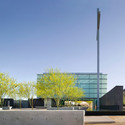
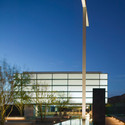
Upon arrival the exposed-aggregate plaza is met by an orderly, yet inviting bosque of desert trees, offering an instant canopy of shade and an elevated vista of the horizon. Bordering the eastern edge of the plaza is a 70 foot-long black reflection pool. Emerging from the mirror-like surface of the water, a flame burns adjacent a 50 foot-high steel cross. Lit from below the water, the slender steel cross is visible for miles.
Envisioned as a ‘lantern on a hill,’ the minimal square chapel sits suspended eight feet above the ground, defined by four Vierendeel steel frames supported on a pinwheel of four black-concrete monolithic walls. Each wall anchors a corner of the ‘glass box’ chapel. The remaining length of wall extending into the landscape captures and defines three unique courtyards around the building.

The physical enclosure of the chapel is entirely glass. Above the eight foot datum, an outer steel frame is connected directly to the main structural frames and is glazed with a layer of fritted-translucent glass that, in turn, shades the inner-layer of triple-insulated translucent glass. The five foot-deep air-space created by the shaded void between the double skins is a natural convection air chimney, releasing hot surface-air while drawing cooler shaded-air along the face of the building. The convection chase and shaded skin eliminate direct sunlight upon the interior glass, creating a soft glowing interior and removing the need for electric light during the daytime.

Below the eight foot datum, and on three sides of the building, stacking, sliding glass doors define the interior and then retract, blurring the line between indoor and outdoor space. When the doors are opened, the chapel is transformed into a ‘pavilion’ able to accommodate thousands during the temperate months of the year.

Facing west, the processional entrance into the space is defined by translucent glazing which flanks a pair of monumental, cast-bronze doors artistically inscribed with the Lord’s Prayer. Lacking exterior hardware, hands will patina the doors over time, further revealing the haptic realm of the building.

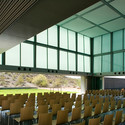
The powerfully minimal interior is subject to the day-lit glow of the upper shaded glass as well as encompassing views of the surrounding landscape, near and distant, afforded by the transparent lower, clear glass. The flooring is a seemingly random pattern of deep charcoal granite. When air conditioning is required, it is carried underground from the adjacent support building and delivered from the eight foot datum.

Three distinct outdoor spaces are defined by the black concrete wall extensions: a paved piazza to the south, a turf lawn to the east, a desert gravel bosque to the north. Moreover, the east-facing sides of two of the four concrete walls contain more than 1000 columbarium niches to memorialize loved ones or inter remains.

Adjacent to the west lies a quietly reposed concrete support building, resolved to a simple rectangle nestled into the ground at the transition between entry garden and chapel mount. Within are offices, a meeting room, restrooms, and mechanical equipment, thus preserving the purity of the chapel as hallowed ground. Parking is located at the base of the garden entrance, also maintaining an appropriate pedestrian buffer between sacred and profane.

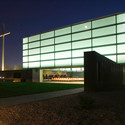
At night the glass pavilion is further transformed by light. Illuminated by hundreds of LED fixtures mounted between the double skins, ‘the lantern on the hill’ morphs into intense, sublime hues of color and shade, a glowing, unique, and fascinating environment created by each color shift.
 

14 comments »

Sublime!

 
# January 20, 2009 at 21:41
VANYUDHISTIRA says:

GREAT BUILDING..

 
# January 20, 2009 at 23:11
MZ says:

I don´t know about this. On the one side it is a very well executed building, great use of materials, even a good spatial concept. On the other side the rather conventional raster-look of the outer skin and the almost commercial ceiling take a lot of sacrality away: too rational, almost like an office building. This chapel would like to be a glas cubus from far, but this theme is so often made, so overused and abused, that it would have taken a little more effort to give it the necessary religious touch.

 
# January 21, 2009 at 04:41
Cameron says:

Architecture,art,the landscape……religion, a perfect composition.

 
# January 21, 2009 at 05:12
simon says:

I agree with MZ. The concept and composition of elements and experiences are strong, however it seems to need another level of attention to give it a more distinct identity as a sacred space. On a few of those images, if you cover the cross, it can look a little like another office park. The glass box lantern expression need extra care in its treatment (rational or not) to not be thrown in with the overused and abused group.

 
# January 21, 2009 at 09:18
utopian robot says:

what a beautifully detailed cube. the relationship with the site is spectacular. the evening mass must feel quite otherworldly. the cross shaped plan evokes geometry that extends beyond a strictly christian tradition. when the trees mature this will feel like a welcoming oasis, which is another potent metaphor for this structure. despite phoenix being a sprawl city they are slowly accumulating some beatiful contemporary architecture.

 
# January 21, 2009 at 09:42
Greg says:

Wow. Very well executed. The experience of this space would be incredible. To propose an option to MZ and Simon’s criticism, I wonder if the spatial experience would be enhanced if the perimeter walls of the ‘floating cube’ were a solid mass – similar to the cast-bronze doors – and the ceiling was clad in the translucent glazing appearing as a seperate volume projecting from the solid mass and serving as the ‘lantern’?

 
# January 21, 2009 at 15:01
pascal says:

great stuff arch daily.

dont ever follow in the footsteps of blogs like dezeen. its nothing but bling bling architecture. sure those images look ultra cool for the first 5 seconds of viewing them, but none of it is real serious architecture like you guys post up on here.

cheers.

 
# January 21, 2009 at 21:56
Rokas says:

It has no chapel-like tipology.The lower part is ok-the connection with surraunding,the in-out effect-but the glass box is totally an office building!!

 
# January 22, 2009 at 08:06
Darren says:

Beautiful. Almost makes we want to go to church.

 
# January 22, 2009 at 18:30
Chad says:

You have to visit this one to truly appreciate it. The cube changes color as it gets dark. The rationality and simplicity allows for contemplation. It is a very powerful space. The doors open up completely on all four sides. Also the procession up to it is very powerful. Don’t be so quick to criticize the “form” of a building. A lot of what is being designed right now is formal BS. I recommend checking this one out for yourself!

 
# January 24, 2009 at 01:02

Links to this article »

Leave a Reply »

Want to have your own avatar? Get yours at Gravatar.

Latest Comments »

What basic rules of the eye perspective?[+]
I liked much this project… It’s true that...[+]
This is certainly a mixture of styles but somehow it feels quite...[+]
What an innovative, unique yet modest project this...[+]
you are a true knower of contemporary architecture, i...[+]
i actually quite like it! because the material was kept...[+]
l.a. w.e.a f.e.a[+]
Why waste space by not giving it to people?[+]
At least you would add some...[+]
A linear plan that works. Access to full...[+]
i’m with mr.cheap on this one, this largely reminds me of a much less...[+]
Can somebody get into the web page? 406 Not...[+]

Browse by category »

Our partners »

Browse by date »

Friends »

Proudly hosted at »