
Have you seen our interviews in High Definition?

Consorcio Building Concepcion / Enrique Browne

By Nico Saieh — Filed under: Institutional Architecture , Offices , Selected , , , , ,
 

Architects: Enrique Browne y Asociados Arquitectos
Location: Concepción, Chile
Associated Architect: Patricio Browne
Collaborators: Enrique C. Browne, Sebastián Morandé, Davor Pavlovic
Project year: 2003-2004
Site Area: 1,096 sqm
Constructed Area: 3,789 sqm
Structural Consultants: Ruiz y Saavedra Ingenieros
Contractor: Ignacio Hurtado y Cia.
Technical Inspection: Juan Eduardo Mujica
Photographs: Guy Wenborne


The rainy city of Concepción, is located in the mouth of the Bío-Bío River, 520 Km south of Santiago. It has aprox. 220.000 inhabitants, but its threshold spans reaches some 630.000 people. The highlights of its economy are the elaboration of steel and the wood industry, both on wide exporting booms. We were asked to design a branch of the ‘Consorcio Nacional de Seguros’, National Insurance Consortium, in a corner site, in front of the only historic and antique church in Concepción, whose façade had been unfortunately reconstructed after an earthquake. Furthermore, it had a front fenced square that impoverished its quality and public character.

site plan

A first version was carried out. It consisted in a triangular building with the vertical circulation organized in a glazed tower in the south. Because the triangular building spun the first two floors in a double height space, a square was created, which joined to the church’s square, creating an environment of urban interest. In turn, the double point of the corner cantilever emphasized the building presence from the busy San Martin Street. The building was clad in copper. The glazed sectors had a ‘double skin’ with climbing plants on the North and West sides. This solution was eliminated for being expensive.


A simpler and more rectangular proposal was developed. The building also withdraws on the west to visually enlarge the square, which passes by the street, joining the old church to the new building. A interesting public space would be added to Concepción.

The building is composed basically by three elements:

exploted axo

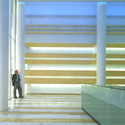
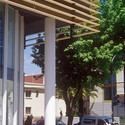
a) A free plant “volume” that looks to the East, North and West, protected from the sun by laminated wood sections that support a “double green skin” with mature climbing plants. The wood use alludes to the regional production;

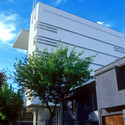
b) A “plan-volume” vertical to the South that flies over the square. Improves the energetic conservation of the building. It is clad in undulated metal plates, a material very utilized in the South of Chile in an economic version. Reminds as well the production of regional steel. Its tall and large windows allow views towards the hills of Concepción, but block the sight of the haphazard roofs of the city and;

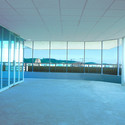
c) A great “horizontal” cantilever roof that serves as an end of the building and protects the large balcony of the upper floor from the western sun wich has the view to the Bío-Bío river. In turn, emphatizes the relation with the small squate. These three bodies give the impression of detachment between them and are supported over a glazing membrane in the first two access and customer service levels. More ever, the main entrance is on axis to the church, on the other side of the square.


19 comments »

raúl says:

I think that he is borjahuidobroing

 
# January 10, 2009 at 15:35
nico says:

raúl

What do you mean with that?

 
# January 10, 2009 at 18:24
Boris says:

“The glazed sectors had a ‘double skin’ with climbing plants on the North and West sides. This solution was eliminated for being expensive.”

Confusing. In the photos it looks like the trellis-ey structure was built but no climbing plants were installed. Are we supposed to believe a few vines were cost-prohibitive? Their shade would have probably lowered air conditioning costs.

 
# January 10, 2009 at 20:07
xing says:

The first image confused me a bit at the first glance. I thought it is a rendering image.

 
# January 10, 2009 at 21:43
raúl says:

borjahuidobroing = to be turning into style of the architect Borja Huidobro

 
# January 11, 2009 at 03:48
Jasper, from Holland says:

@xing: confused aswell, i think it is a rendered image, because the text points out that the initial plan had plants on the north and west sides, which were eliminated

@Boris: Installing plants is more then just the plants itself, the whole construction supporting the soil as the drainage and water supply of the plants is quite extensive, making it expensive. And maybe there was already sufficient shading. Shame Though, really like green buildings (if they manage to be as green as on the renders)

Overall i think it looks really nice, detailing as far as i can see is really clean ^^

*goes check out borja huidobro architecture*

 
# January 11, 2009 at 07:04
Boris says:

Things need only be as expensive and complicated as we make them. A trench, some containers and growing medium, and a bit of effort to maintain – how difficult is that? People are all gung-ho on greening everything but it’s often the first thing to be cut as soon as someone raises the slightest objection.

The details, “planting scheme” and “planter detail” above look quite wonderful with various flowering and non-flowering species. Without them this building is just another competent modernist box with little to distinguish it from thousands of others around the world.

 
# January 11, 2009 at 11:41
Hamster says:

Raul,
I think you have in mind the “Santiago´s Consorcio” building…but maybe you don´t know that building was actually design by Borja and Brown.

Brown is the one intrested in combining nature and architecture

 
# January 11, 2009 at 23:12
Hamster says:

By the way….plants are already growing..

 
# January 11, 2009 at 23:13
Hamster says:

>>Santiago´s consorcio building…http://www.barqo.cl/v1/proyecto.php?tipo=39

 
# January 11, 2009 at 23:14
Cristian says:

The first image is an actual photo, but retouched in Photoshop. The original one was taken when the building was just made, and also showed some electrical cables that where removed as well…. as I ‘ve been told.

 
# January 16, 2009 at 17:46
thanhtran says:

creativity and contribute to the green city, but still very impressive and modern …….. unfortunately not exploited hygiene of the front, supporting this school all his

 
# July 16, 2009 at 06:05
luxo says:

No one is thinking about water here…it’s why plants get zapped when money is involved.

 
# September 2, 2009 at 13:33

Links to this article »

Leave a Reply »

Want to have your own avatar? Get yours at Gravatar.

Latest Comments »

Stourley Kracklite on 4 Houses / On Office:
I like purism as well as the next guy, so I am very interested in how the...[+]
I like the overall design of it, but in combination with the abandoned dessert location...[+]
I like the yurt argument… yes, it is clearly a client-wooing...[+]
Don’t ask… you’ll just get some lengthy BS answer.[+]
Yes, this is clearly a yourt inspiration :rollseyes:[+]
I like this building … but the pretentious,kitchy heart? …why?[+]
I like the project… a lot. Reading the description, however, makes me want to...[+]
jurgen meier called, he wants his design back.[+]
El Centro Pompidou fue terminado en 1977…[+]
I agree with the comment of ema, any architect should take...[+]
The archetype form they show for a yurt doesn’t even look correct. It looks more...[+]
a Beaubourg coming a little bit late[+]

Browse by category »

Our partners »

Browse by date »

Friends »

Proudly hosted at »